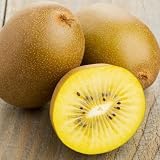
Care Guide: Planting, Soil & Watering
Overview: The golden kiwifruit is a vigorous deciduous climbing vine that grows best in full sun on a sturdy trellis, in deep, fertile, well-drained soil. It is a thirsty plant that likes steady moisture through the growing season, yet it resents waterlogging and needs sharp drainage at the roots.
Quick Care Requirements
| Requirement |
Ideal Condition |
| Planting Season |
Spring, after the last frost |
| Growth Rate |
Moderate to Fast |
| Soil Type |
Deep, fertile, moisture-retentive but well-draining |
| Soil pH |
Slightly acidic to neutral (about 5.5–7.0) |
| Water Need |
Moderate to High – keep evenly moist in the growing season, never waterlogged |
Planting & Establishment
- Best Planting Season: Plant in spring once the soil has warmed and the risk of frost has passed, giving the vine a full season to establish before winter dormancy.
- How to Plant:
- Hole Preparation: Dig a hole noticeably wider than the root ball and loosen the surrounding soil so the vigorous roots can spread; set a strong trellis or support in place first.
- Soil Amendments: Work plenty of compost or well-rotted organic matter into the backfill to enrich the soil and improve moisture retention, while keeping the site free-draining.
- Planting Depth: Set the vine at the same depth it grew in the nursery, with the root collar level with the surrounding soil – do not bury the stem or any graft union.
- Growth Speed & Expectations: Growth is moderate to fast; once established the vine climbs vigorously and needs room and regular training on its support.
Soil, Watering & Drainage Care
- Soil Mix & Drainage Needs: Provide a deep, fertile, well-drained soil. Kiwi roots need oxygen, so heavy or compacted ground should be opened up with organic matter; in a large container use a rich, free-draining potting mix with ample drainage holes to prevent root rot.
- Watering Schedule & Technique:
- Young / Newly Planted: Water frequently and thoroughly to keep the root zone evenly moist while the vine establishes, without leaving it standing in water.
- Established: Water deeply and regularly through the growing season; the vine is thirsty, so let only the top few centimetres dry before watering again.
- Seasonal Adjustments: Increase watering in summer heat and while fruiting, and cut back as the vine drops its leaves and goes dormant in winter.
Growing in Pots, Balconies & Indoors
Golden kiwifruit (Actinidia chinensis) is a large, vigorous deciduous vine reaching 3-7 m, grown for its fruit. The grower does not treat it as a houseplant – it is far too big and needs full sun, a strong support, winter chilling and usually both a male and a female plant to fruit. It can be grown in a large container on a sunny patio while young or as an ornamental, but it is an outdoor plant.
Quick Details
- Container Size: A large, heavy container with a strong trellis or pergola support; pot up as the vine grows
- Indoor Suitability: Not indoors – a 3-7 m vine that needs full sun and winter cold; grow it outdoors
- Best Spot: Full sun, outdoors, with a sturdy support to climb
- Soil & Drainage: Well-drained, organic-rich mix; strong drainage holes
- Watering in Pots: Average to generous – the vine is thirsty in growth, so keep it evenly moist, but never waterlogged; pots dry fast
Indoors & On the Windowsill
- Too large for indoors: As a 3-7 m vine, this is not a houseplant. It needs full sun, a big support and a cold winter dormancy to fruit, none of which suit a room.
- Fruiting needs: Remember it usually needs a male and a female plant (about one male to several females) to set fruit, plus winter chilling – so container growing indoors will not produce a crop.
On a Balcony or Patio
- Light, support & wind: Give it the sunniest spot and a strong trellis, pergola or railing to climb – it is heavy and vigorous. Shelter it from strong wind, which can tear the large leaves and shoots.
- Watering & weight: A thirsty vine in a fast-drying pot needs frequent watering in warm weather. The full pot plus support is heavy, so set it up in place and ensure runoff drains away.
Choosing the Pot, Soil & Long-Term Care
- Pot & drainage: The largest sturdy pot you can manage, with strong drainage holes; skip a standing water saucer. Plastic or glazed pots hold moisture better than terracotta for this thirsty plant.
- Potting mix: A well-aerated, organic-rich mix – coir or peat with perlite for drainage.
- Feeding: Feed regularly through the growing season, as this vigorous, potted vine leaches and uses nutrients quickly.
- Repotting: Pot up as it grows and refresh the mix; prune hard in autumn/winter to keep the vine within the support and the pot manageable.
Bloom & Flower Guide
Quick Details
- Bloom Season: Spring into summer
- Time to First Bloom: Vines take a few years of growth before they flower, typically from around their third to fifth season
- Flower Appearance: White to cream flowers borne in small clusters; male and female flowers grow on separate plants
- Edibility: The flowers are not eaten — the vine is grown for the fruit that follows
Detailed Blooming Overview
Golden kiwifruit is a vigorous vine that flowers in late spring, opening cupped white-to-cream blooms in clusters. The important thing at bloom time is that the plant is dioecious — male and female flowers are carried on separate vines. A female vine only sets fruit if a male vine is flowering nearby at the same time and pollinators carry pollen between them, so both sexes are essential for a crop.
Flower Characteristics
- White to cream flowers, cupped and carried in small clusters.
- Male and female flowers look broadly similar but grow on separate plants.
Bloom Care & Thinning
- Plant both sexes: Grow at least one male vine near your female vines, flowering at the same time, or no fruit will set.
- Pollination: Bees and flies move the pollen; the flowers offer little scent, so a strong pollinator presence during the short bloom really helps.
- Support and light: Train the vine on a sturdy frame in full sun so light reaches the flowering wood.
Pruning, Training & Seasonal Maintenance
Golden kiwifruit plant is a vigorous deciduous vine that needs permanent trellis or pergola support and firm annual pruning to stay productive rather than collapsing into a tangled, shaded mass. It fruits on current-season shoots that arise from buds on one-year-old canes, so the main objective of dormant pruning is renewing that fruiting wood every year while keeping the vine’s size on its support in check. Because male and female flowers grow on separate plants, and only about one male is needed for every eight female vines, the two sexes are pruned somewhat differently once mature. The safe structural window is dormancy (autumn into winter), but timing matters more here than on most woody plants: kiwifruit bleeds sap heavily if cut too close to bud break.
Quick Pruning & Maintenance Specs
| Pruning Tolerance |
High (vigorous vine; expects substantial annual wood removal) |
| Primary Pruning Window |
Autumn to early winter, well into dormancy |
| Secondary Maintenance Window |
Summer shoot thinning and tipping for vigor and light |
| Typical Frequency |
One major dormant prune per year, plus summer touch-ups |
| Main Objective |
Renew one-year fruiting canes on the permanent cordon; control vigor and size on the support structure |
| Young Plant Priority |
Train a single trunk to a permanent leader/cordon on the trellis wire |
| Mature Plant Priority |
Annual replacement of spent fruiting canes with new one-year wood along the cordon |
| Best Tool Type |
Bypass secateurs for one-year canes; loppers or a pruning saw for older cordon wood |
| Avoid Heavy Pruning During |
Late dormancy close to bud break, when cuts cause heavy sap bleeding |
Pruning by Plant Age & Size
Newly Established
Train a single strong shoot up to the trellis wire as the permanent trunk/leader, removing competing shoots below it; the young plant needs this framework established before any fruiting-wood management begins.
Young / Formative
Once the leader reaches the wire, select and tie in permanent lateral cordons along the support (an espalier-like framework), and pinch back vigorous laterals to encourage branching along the cordon rather than one shoot racing away.
Mature / Established
Each dormant season, remove canes that fruited the previous summer (they do not fruit again in the same spot) and select vigorous new one-year wood as replacements, spaced along the permanent cordon.
Seasonal Pruning Schedule
Dormant/Winter
Objective: renew fruiting wood on the permanent framework, matching the plant’s own recorded pruning season. Remove spent fruiting canes, thin overcrowded new wood, and prune as early in dormancy as practical rather than close to bud break. Do not remove the permanent cordon wood itself. Expected response: vigorous regrowth from remaining buds; fruiting impact: this is the pruning that sets up next season’s crop, since new fruiting shoots arise from the retained one-year canes.
Summer Canopy Management
Objective: manage vigor and light during the growing and fruit-sizing season (harvest itself runs summer into autumn). Thin overcrowded or misdirected shoots and tip overly vigorous non-fruiting growth; avoid stripping so much foliage that developing fruit loses the leaf area it needs to size and sweeten.
Flowering & Fruiting Wood
Flowers, and later fruit, form on current-season shoots that grow from buds on one-year-old canes – there is no fruiting on older, multi-year wood. This means the previous winter’s cane-selection pruning directly determines the coming season’s crop: keeping enough well-placed one-year wood is essential, while canes that already fruited are typically removed since they will not fruit again from the same points.
Structural Pruning & Training
Maintain the permanent cordon/trellis framework and renew fruiting laterals off it every year – this is a cordon or T-bar training system, not a free-standing tree form. Thin canopy density where shoots overlap, since good light penetration matters for fruit set and quality on a vine this vigorous, and control height and spread at the edges of the trellis or pergola.
Special Growth to Remove
- Spent one-year canes that already fruited (removed to make room for replacement wood).
- Overcrowded competing shoots arising at the same point on the cordon.
- Vigorous non-fruiting whip-like shoots that shade the canopy without contributing fruit.
- On male vines, once flowering (and pollen shed) is finished for the season, prune more freely for size and vigor control, since no fruiting wood needs to be preserved on a male plant.
Container & Small-Space Pruning
Container growing is possible per the plant’s own care record, but this remains a vigorous vine that still needs a sturdy trellis even in a pot – root confinement does not remove the need for support. Expect to prune harder and more often for size control than an in-ground vine, since there is no room for the framework to spread.
Tools
- Bypass secateurs for one-year fruiting-cane renewal cuts.
- Loppers for thicker sections of the permanent cordon.
- Soft ties or stakes for training new leaders and laterals onto the trellis wires.
Tool Hygiene & Disease Risk
Routine: clean, sharp tools are sufficient under normal conditions; step up to disinfecting between cuts only if canker, dieback or other diseased wood is found, since none of the plant’s own pest/disease notes flag a high routine transmission risk.
Cut Placement & Technique
Remove whole spent fruiting canes with a thinning cut back to the cordon rather than leaving long stubs; head new replacement canes to a strong bud at the desired length and tie them along the wire. Avoid heading cuts mid-cane, which produces weak, poorly placed regrowth instead of well-spaced fruiting wood.
Heavy Pruning & Rejuvenation
Unlike most trees, substantial annual wood removal is normal here, not an emergency measure – a large share of the previous season’s growth is expected to be cut away every dormant season as part of routine cane renewal. If the permanent trunk or cordon itself is damaged, it can be rebuilt from a strong new shoot arising near the base, though this costs a crop cycle or two while the new framework is trained back onto the trellis.
Post-Pruning Care
Prune as early in dormancy as practical to limit sap bleeding, which is largely cosmetic but can be heavy; avoid additional stress (such as major root disturbance) at the same time as a hard structural prune. Check and adjust ties on new leaders and laterals so wind does not tear soft growth away from the trellis.
Common Pruning Mistakes
- Pruning too late in dormancy, close to bud break, causing heavy sap loss.
- Failing to renew fruiting canes each year, letting the vine become a shaded tangle with declining fruit quality.
- Over-pruning the male vine before it has finished shedding pollen, when female vines still need it for that season’s pollination.
- Under-building the trellis for how much wood a mature vine actually carries.
When NOT to Prune
Avoid dormant pruning right at bud break because of heavy sap bleeding. Avoid heavy summer pruning while fruit is sizing and ripening (summer into autumn per the plant’s own harvest record), since removing too much leaf area reduces fruit quality. On a male vine still needed for pollination, avoid removing flowering wood before bloom is finished for the season.
Recommended Tools (by task)
- bypass_secateurs – annual renewal cuts on one-year fruiting canes.
- loppers – removing thicker old cordon wood during framework maintenance.
- soft_ties_stakes – training new leaders and laterals onto the trellis or pergola wires.
Pruning Troubleshooting
| Problem |
Possible Cause |
What to Check |
Corrective Action |
| Poor fruit set on a female vine |
Inadequate pollination – male vine missing, too few, or blooming out of sync |
Confirm a male vine is present near the roughly one-to-eight ratio and blooms overlap |
Retain or add a male vine timed to the females’ bloom; consider hand pollination if bees are scarce |
| Declining yield year over year |
Fruiting canes not renewed – old unproductive wood retained |
Check whether canes carrying fruit are new (one-year) growth or older wood |
Apply annual dormant renewal, replacing spent canes with fresh one-year wood |
| Heavy sap bleeding after pruning |
Cuts made too close to bud break |
Compare pruning date to the timing of spring bud swell |
Prune earlier in dormancy the following year; bleeding is usually cosmetic, not fatal |
| Small or poorly colored fruit in a dense canopy |
Overcrowded, unthinned canopy shading developing fruit |
Check light penetration to fruiting canes |
Thin overlapping shoots in summer and open the framework at the next dormant prune |
Pests, Diseases & Troubleshooting
Overview: Golden kiwifruit (Actinidia chinensis) is a vigorous deciduous vine whose biggest threats are diseases rather than insects — above all the bacterial canker Psa, plus root and crown rots in wet ground and grey mould on fruit — while scale, mites and leafrollers are the main pests. The management philosophy is preventive and cultural: strong airflow through an open, well-pruned canopy, clean tools, healthy free-draining soil, and vigilant sanitation, with sprays reserved as back-up. A quirk worth knowing: like catnip, kiwi vines contain actinidine and attract cats, which can shred young stems.
Quick Troubleshooting Overview
| Issue / Pest |
Main Symptom |
Primary Solution |
| Bacterial canker (Psa) |
Red-rusty ooze/cankers on canes, angular leaf spots with yellow halos, wilting |
Prune out in dry weather, sanitise, copper sprays, resistant stock |
| Scale insects |
Brown/white bumps on canes and fruit; sooty mould, downgraded fruit |
Winter oil, prune congestion, encourage parasitic wasps |
| Spider mites |
Leaf stippling, bronzing and early leaf drop in hot dry spells |
Maintain vigour/moisture, conserve predatory mites |
| Leafrollers |
Rolled, webbed leaves; caterpillars scarring fruit surface |
Hand-remove, Bt spray, pheromone monitoring |
| Botrytis grey mould |
Grey fuzzy rot on flowers and stored fruit |
Open canopy, careful harvest/handling, cool storage |
| Crown/root rot |
Poor growth, wilt, dark rotten crown in wet soil |
Improve drainage, avoid waterlogging, raised planting |
Common Pests & Management
- Armored & soft scale (Hemiberlesia rapax, Coccus hesperidum):
- Symptoms: Small brown, grey or white limpet-like bumps encrusting older canes, leaf ribs and the fruit surface, causing sticky honeydew, sooty mould and cosmetically downgraded fruit. Heavy scale weakens vines.
- Prevention & Control: Prune out congested, shaded wood to open the canopy and expose scale to predators and parasitic wasps (encourage these first). A horticultural mineral oil in the dormant/winter season smothers overwintering scale; time it to protect pollinators and follow the label.
- Two-spotted spider mite (Tetranychus urticae):
- Symptoms: Fine pale stippling then bronzing of leaves in hot, dry, dusty conditions, with premature leaf drop that stresses the vine and its fruit-ripening.
- Prevention & Control: Keep vines vigorous and evenly watered (drought-stressed vines flare mites), damp down dust, and conserve naturally occurring predatory mites and lacewings by avoiding broad-spectrum insecticides. Spot-treat bad outbreaks with horticultural oil.
- Leafroller caterpillars (Ctenopseustis, Planotortrix spp.):
- Symptoms: Leaves rolled and webbed together sheltering green caterpillars; surface scarring and silvering where larvae graze on developing fruit, downgrading it.
- Prevention & Control: Monitor with pheromone traps, hand-remove rolled leaves, and support natural parasitoids. A targeted Bacillus thuringiensis (Bt) spray controls young larvae with minimal harm to beneficials.
- Thrips (Thrips / greenhouse thrips):
- Symptoms: Silvery russeting and fine dark specks (frass) on leaves and around the calyx of the fruit, causing skin blemishing.
- Prevention & Control: Reduce weedy hosts nearby, keep vines healthy, use blue sticky traps to monitor, and rely on predatory mites and lacewings; treat only if damage is economic.
- Root-knot nematodes (Meloidogyne spp.):
- Symptoms: Galls and knots on roots, with above-ground stunting, yellowing and drought-like wilting despite adequate water, especially in sandy warm soils.
- Prevention & Control: Plant into clean, nematode-free ground, build up organic matter and beneficial soil life, mulch to keep roots cool and vigorous, and rotate/avoid replanting into known infested sites.
- Vertebrate pests — cats & birds:
- Symptoms: Cats are drawn to the vine’s actinidine and rub, chew and snap young stems and new plants; birds peck and strip ripening fruit.
- Prevention & Control: Protect young vines with a wire cage or mesh collar until the trunk hardens; net the canopy or use bird deterrents as fruit softens near harvest.
Diseases & Fungal Issues
- Bacterial canker — Psa (Pseudomonas syringae pv. actinidiae):
- Symptoms: The most serious kiwifruit disease. Angular brown leaf spots with bright yellow halos, red-rusty or milky ooze bleeding from cankers on canes and trunk, wilting shoots, blackened buds/flowers and cane dieback. Spreads in cool wet weather and through pruning wounds.
- Treatment & Management: There is no cure once systemic, so prevention rules: plant tolerant cultivars/rootstocks, prune only in dry weather, disinfect tools between cuts, remove and destroy infected wood well below symptoms, protect wounds, and avoid overhead irrigation and excess nitrogen. Copper-based bactericides and elicitor programmes help suppress spread; keep vines unstressed.
- Botrytis grey mould (Botrytis cinerea):
- Symptoms: Grey fuzzy rot on flowers, and the main post-harvest rot of stored fruit, entering through the picking scar and spreading in cool damp storage.
- Treatment & Management: Keep an open, airy canopy, remove spent flowers and debris, harvest at the right maturity, handle fruit gently to avoid wounds, cure the stem scar, and store cool and dry with good ventilation.
- Phytophthora crown & root rot (Phytophthora spp.):
- Symptoms: Kiwifruit is very sensitive to waterlogging. Vines decline, wilt and yellow with a dark rotting crown and root system; often fatal in heavy or poorly drained soil.
- Treatment & Management: Plant on well-drained ground or raised mounds, never in a wet hollow, water deeply but let soil breathe, and avoid piling mulch against the trunk. Improve drainage before replanting affected sites.
- Crown gall (Agrobacterium tumefaciens) & Armillaria root rot:
- Symptoms: Crown gall forms rough tumor-like swellings at the base and roots, entering through wounds; Armillaria (honey fungus) causes white fan-like mycelium under the bark and slow collapse, especially on old tree sites.
- Treatment & Management: Use clean planting stock, avoid basal/root wounds and poor drainage, and remove badly galled or Armillaria-infected plants with their root debris; do not replant kiwi into known honey-fungus ground.
Growing Difficulties & Abiotic Problems
- Spring frost & wind damage:
- Cause & Symptoms: The vine leafs out early; late spring frosts blacken new shoots and flowers, cutting the crop, and the large soft leaves shred and brown in strong wind.
- Correction Strategy: Site in a sheltered spot with wind protection, avoid frost pockets, and delay pruning/train growth to reduce early exposure; protect young vines on frost nights.
- Iron/lime-induced chlorosis:
- Cause & Symptoms: On alkaline or waterlogged soils, young leaves yellow between green veins (interveinal chlorosis) as iron/manganese uptake fails.
- Correction Strategy: Improve drainage, add organic matter, keep soil slightly acidic to neutral, and correct with chelated iron and acidifying feeds where needed.
- Sunburn on trunk & fruit:
- Cause & Symptoms: Exposed trunks and fruit suddenly bared by heavy pruning or defoliation scald and crack in strong sun and heat.
- Correction Strategy: Maintain leaf cover over the fruit, avoid stripping the canopy, and whitewash or shade exposed trunks in hot climates.
- Failure to fruit (pollination & chill):
- Cause & Symptoms: No or poor fruit set because male and female vines are both needed and enough winter chill hours are required; poor bee activity also limits set.
- Correction Strategy: Grow compatible male and female vines (roughly one male to several females) or a self-fertile cultivar, choose a variety matched to your chill, and support pollinators at bloom.
What Helps — Products & Tools
For golden kiwifruit the mainstays are copper-based bactericide/fungicide (for Psa and leaf/flower infections), dormant horticultural mineral oil (scale and mite eggs), Bacillus thuringiensis (Bt) for leafrollers, pheromone and sticky traps for monitoring, bird netting and a trunk guard/cage against birds and cats, plus chelated iron for chlorosis. Clean, disinfected pruning tools, an open airy canopy and well-drained soil prevent far more damage than any spray.
Propagation Guide
Because this vine is dioecious (separate male and female plants) and the site notes vegetative propagation is needed to get a cultivar that fruits without requiring both sexes, grafting onto seedling rootstock or rooting cuttings from a known plant are the recommended routes rather than seed. Difficulty is Moderate for cuttings and Moderate to Difficult for grafting, which takes more practice to do reliably.
Quick Propagation Specs
| Best Propagation Method |
Grafting onto seedling rootstock (for named or self-fertile cultivars) |
| Alternative Methods |
Semi-hardwood stem cuttings under mist (for own-root plants) |
| Propagation Difficulty |
Moderate (cuttings); Moderate to Difficult (grafting) |
| Seed True-to-Type |
No – seedlings’ sex and self-fertility can’t be predicted, and fruit quality varies |
| Vegetative True-to-Type |
Yes |
| Best Propagation Season |
Grafting and hardwood cuttings in the dormant season before spring growth; softwood cuttings in early summer |
Growing from Seed
The site does not list seed as a recommended way to start this plant, and for good reason: seedlings won’t reveal their sex until they mature, and the self-fertile, no-separate-male-needed trait the site highlights would not be reliably passed on. Seed is really only useful for breeding or producing rootstock, not for growing a known fruiting vine.
Stem Cuttings
Cutting Type
Semi-hardwood cuttings from the current season’s growth are the common way to propagate an own-root plant of a known vine.
Rooting Setup
Root under high humidity (misting) in a well-drained propagating mix.
Rooting Hormone
A rooting hormone is commonly used to improve success and is beneficial though not always essential.
Grafting & Budding
Why Grafting Is Used
Grafting guarantees the exact fruiting cultivar and sex of the parent vine, and is the standard way to establish named or self-fertile selections without waiting years to find out an own-root seedling’s characteristics.
Rootstock
Vigorous seedling Actinidia rootstock is typically used.
Scion Selection
Take scion wood from a known, healthy plant of the desired cultivar.
Best Grafting Season
Dormant season, before spring growth begins.