Care Guide: Planting, Soil & Watering
Overview: Echinopsis chamaecereus (peanut cactus) is a small, drought-tolerant cactus that needs full sun and well-drained soil, tolerating cold to about -3°C. It stores water in its stems and should dry out between waterings to avoid rot.
Quick Care Requirements
| Requirement |
Ideal Condition |
| Planting Season |
In the warm season — spring through autumn |
| Growth Rate |
Slow |
| Soil Type |
Well-draining, gritty or sandy soil |
| Water Need |
Low — let it dry out between waterings |
Planting & Establishment
- Best Planting Season: Plant from spring through autumn, in a sunny, sharply drained spot.
- How to Plant:
- Hole Preparation: Dig a hole a little larger than the root ball in a sunny, sharply drained spot; handle the spiny stems with folded paper or gloves.
- Soil Amendments: Add grit, gravel or sand for fast drainage.
- Planting Depth: Set the stem at its original level and firm the soil gently around the base for stability.
- Growth Speed & Expectations: Slow-growing.
Soil, Watering & Drainage Care
- Soil Mix & Drainage Needs: Needs gritty, fast-draining soil; in containers use a free-draining cactus mix with drainage holes so the roots never stay wet.
- Watering Schedule & Technique:
- Young / Newly Planted: Water lightly after planting, letting the surface dry between waterings.
- Established: Water only once the soil has dried out, then soak thoroughly; avoid leaving it wet.
- Seasonal Adjustments: Keep nearly dry in winter and water a little more in summer heat.
Growing in Pots, Balconies & Indoors
The peanut cactus is a small, clustering desert cactus – not a shade-tolerant houseplant, but an easy, free-flowering choice for the sunniest windowsill or a hot balcony pot.
Quick Details
- Container Size: A snug pot only slightly wider than the clump; shallow is fine, as the roots stay near the surface
- Indoor Suitability: Not a general houseplant; grows and flowers best on the brightest, sunniest sill
- Best Spot: Full sun
- Soil & Drainage: Free-draining cactus mix with grit; drainage holes essential
- Watering in Pots: Small amounts – let it dry out between waterings
Indoors & On the Windowsill
- Not a deep-room houseplant: The grower notes it is not suited to indoor life as a general houseplant – it needs far more light than a room interior offers, or it etiolates and will not bloom.
- Windowsill growing: On the sunniest sill it thrives, clustering into offsets and flowering freely with enough direct sun.
- Winter rest: A cool, nearly dry dormant period encourages the following flush of blooms.
On a Balcony or Patio
- Light & heat: It relishes a hot, sunny, sheltered spot; heat reflected off walls and railings suits it, though the small pot dries fast – keep it on the dry side.
- Practicalities: Bring it under cover before cold, wet weather sets in.
Choosing the Pot, Soil & Long-Term Care
- Pot & drainage: A snug pot with strong drainage holes; skip a standing saucer of water to avoid root rot. Terracotta breathes and dries fast, which desert cacti prefer.
- Potting mix: A proper cactus/succulent mix – free-draining and mineral – with extra grit, pumice or perlite.
- Feeding: An occasional dilute cactus feed during active growth only.
- Repotting: Pot on only every few years, refreshing the mineral mix; it likes a tight root run.
- Safety: Spiny – site it out of reach of children and pets, and handle with folded paper or thick gloves.
Bloom & Flower Guide
Quick Details
- Bloom Season: Spring to summer
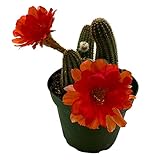
- Flower Appearance: Vivid red-to-orange flowers borne along the finger-like stems
- Edibility: Ornamental — not eaten
Detailed Blooming Overview
The peanut cactus is a small, spreading plant that flowers far out of proportion to its size — in spring and summer it studs its short, finger-like stems with brilliant red-to-orange blooms. It is an easy, free-flowering choice for a sunny windowsill or a well-drained rockery.
Flower Characteristics
- Red-to-orange flowers, large and showy against the small stems.
- Borne along the sides of the finger-like stems.
Bloom Care & Thinning
- Encouraging bloom: A cool, dry winter rest is the key to a good spring flush of buds.
- Care: Bright light and sparing water suit it; each flower lasts a day or two, but they open in succession.
Pruning, Training & Seasonal Maintenance
Echinopsis chamaecereus (Peanut Cactus) is a small, slow-growing, clumping cactus (10–25 cm) with spiny stems that stand erect when young and progressively weep and sprawl as they lengthen and offset into a clump. Its own care data allows cutting year-round, limited to removing dead stem sections and spent flowers — it does not build woody structure or persistent flowering wood, and its red-to-orange flowers form fresh each spring/summer from current growth, so trimming has no bearing on next season’s bloom.
Quick Pruning & Maintenance Specs
| Pruning Tolerance |
Low–Moderate — sanitary removal and occasional thinning, not structural pruning |
| Primary Pruning Window |
Any time of year (per its own care data) |
| Typical Frequency |
Occasional, as dead stems, spent flowers, or overcrowding appear |
| Main Objective |
Remove dead/rotten stem segments and spent flowers; thin an overcrowded clump for airflow and display |
| Young Plant Priority |
Leave undisturbed while it establishes its erect starting habit |
| Mature Plant Priority |
Remove dead stem segments and spent flowers; thin or remove weeping stems that have overgrown their space |
| Best Tool Type |
Precision snips / grafting knife (with gloves — spiny) |
| Avoid Heavy Pruning During |
Not applicable in the structural sense — this plant is never heavily/structurally pruned |
Pruning by Plant Age & Size
Newly Established
No pruning; remove only visibly damaged or rotten stem tissue.
Young / Formative
No structural training — the plant naturally forms erect young stems on its own; no staking, pinching, or leader selection applies.
Mature / Established
As stems lengthen and begin to weep and offset, periodically remove dead segments and spent flowers, and thin out crowded or overly sprawling stems to keep the clump looking tidy and to improve air circulation through the center of the clump.
Special Growth to Remove
- Dead or shriveled stem segments.
- Spent flowers, once faded.
- Excess offsets/weeping stems if the clump has outgrown its space — these root readily where they touch soil, so remove any unwanted rooted segments to control spread, or leave them to fill in the clump if more coverage is wanted.
Container & Small-Space Pruning
Well suited to containers (not typically grown as an indoor houseplant per its own data, but pot culture outdoors/in a greenhouse setting is standard). In a pot the weeping stems will trail over the rim as the plant matures; trim back any stems that have grown beyond the display size wanted, and remove rooted plantlets at the pot’s edge if a tighter clump is preferred.
Tools
Precision snips or a grafting knife for clean removal of dead or spent stem sections; wear thick gloves or use padded tongs, since the stems carry spines despite the plant’s small size.
Tool Hygiene & Disease Risk
Routine. Use a clean, sharp blade; disinfect it after cutting into any rotten tissue before moving to healthy stems, since rot rather than transmissible disease is this cactus’s main vulnerability.
Cut Placement & Technique
Remove a whole weeping/dead stem at its base or at a natural segment joint rather than cutting mid-stem, which leaves an awkward stub; let cuts dry/callus in a shaded, airy spot before watering resumes.
Heavy Pruning & Rejuvenation
Not tolerated as routine practice — there is no woody framework to rejuvenate. An overgrown, leggy clump is better refreshed by taking stem cuttings (which root easily) to start a tidier new plant than by hard-cutting the original.
Post-Pruning Care
Withhold water for several days after any cut to let the wound callus; keep the plant in its normal bright light — no extra feeding is needed after a routine trim.
Common Pruning Mistakes
- Handling the spiny stems bare-handed while trimming.
- Leaving spent flowers or dead segments in place, inviting rot in the humid microclimate of a dense clump.
- Watering immediately after cutting, before the wound has dried.
When NOT to Prune
- During prolonged wet or humid weather, when cut surfaces are slow to callus and rot risk is elevated.
- Right after repotting, while the plant is settling in.
Recommended Tools (by task)
- precision_snips — removing dead stem segments and spent flowers.
- grafting_knife — a sterile blade for clean stem-cutting propagation or precise rot removal.
Pests, Diseases & Troubleshooting
Desert cacti are close to pest-free when grown hard, bright, and dry; their real killer is not an insect but rot from overwatering and cold, wet soil. The pests that do appear are mostly sap-suckers that hide among the spines and on the roots. The soft, finger-like sprawling stems of the peanut cactus are unusually prone to red spider mite (rusty bronzing) and to rot, and they bruise and break easily. Grow in a gritty mineral mix, water sparingly, give strong light and airflow, and inspect the base, growing tip, and roots regularly.
Quick Troubleshooting Overview
| Issue / Pest |
Main Symptom |
Primary Solution |
| Overwatering / soft rot |
Mushy, discolored, foul-smelling tissue at base or tip |
Cut out rot; keep dry and airy; drench-free |
| Mealybugs (incl. root) |
White cottony fluff among spines and on roots |
Alcohol swab; systemic drench for root form |
| Scale |
Grey/white crusty bumps on the body |
Scrape/oil; treat crawlers |
| Spider mites |
Rusty, corky bronzing near the apex; fine webbing |
Rinse; horticultural oil; raise humidity/airflow |
| Slugs / snails |
Chewed scars on soft new areoles and seedlings |
Hand-pick; grit or bait barrier |
| Sunburn / scorch |
Bleached or corky patches after sudden strong sun |
Acclimate gradually; light midday shade |
Common Pests & Management
- Mealybugs, incl. root mealybug (Planococcus citri, Pseudococcus spp., Rhizoecus spp.):
- Symptoms: The most common cactus pest. White cottony masses tuck between ribs, around the wool of the areoles, and at the spine bases, while root mealybugs coat the roots in white wax and stunt the plant unseen. Feeding causes yellowing, weak growth, and honeydew with sooty mould.
- Prevention & Control: Dab colonies with 70% isopropyl alcohol on a cotton swab or fine brush and blast the body clean. For root mealybug, bare-root, wash, and repot into fresh gritty mix in a clean pot, or apply a systemic soil drench. Inspect the roots at every repot and isolate new plants.
- Cactus scale & other scale (Diaspis echinocacti, Coccus spp.):
- Symptoms: Round grey, white, or brown crusty bumps encrust the stem, sucking sap; heavy infestations of the white cactus scale can whiten and disfigure whole plants and weaken them badly.
- Prevention & Control: Scrape off with a soft brush or dab with alcohol, then apply horticultural oil to smother crawlers, repeating to catch new hatchlings. Persistent cases respond to a systemic treatment; check sheltered ribs and the base.
- Spider mites (Tetranychus spp.):
- Symptoms: A hot, dry-air pest that scars the tender skin near the growing tip with rusty, bronzed, corky patches and, when severe, spins fine webbing over the crown. The permanent scarring is often noticed after the mites have moved on.
- Prevention & Control: Rinse the plant and raise humidity and airflow around it. Spray a light horticultural oil or insecticidal soap, covering the crown, and repeat at intervals; predatory mites help in collections. The corky scars do not heal but new growth is clean once mites are gone.
- Cactus longhorn beetle (Moneilema spp.):
- Symptoms: In the Americas these flightless black longhorn beetles and their grubs chew notches in the stem and bore into the base and roots, and the wounds they open frequently become entry points for lethal soft rot.
- Prevention & Control: Hand-pick the conspicuous adults at dusk and destroy grubs found at the base; keep plants vigorous and wounds clean. Where they are a known local problem, protect valued specimens and treat fresh damage promptly to head off rot.
- Slugs & snails (Deroceras spp.):
- Symptoms: In damp conditions and greenhouses they rasp the soft skin of new growth, seedlings, and flower buds at night, leaving scars and slime that spoil the plant and open the door to rot.
- Prevention & Control: Hand-pick after dark, remove damp hiding places, and ring plants with grit or diatomaceous earth; iron-phosphate bait is a pet-safe option. Keeping the surface dry deters them.
- Fungus gnats (Bradysia spp.):
- Symptoms: Small black flies over the soil signal an over-wet mix; their larvae live in constantly moist medium and can nibble fine roots and seedlings, but their main message is that the pot is being kept too wet.
- Prevention & Control: Let the mix dry out fully, add a gritty top-dressing, and use sticky traps and Bti or nematodes for larvae. Correcting watering is the real fix and also prevents rot.
Diseases & Fungal Issues
- Bacterial soft rot (Pectobacterium/Erwinia spp.):
- Symptoms: The fast cactus killer. Starting from a wound or from cold, wet tissue, the flesh turns soft, mushy, and discolored (orange-brown to black) and smells foul, spreading rapidly through the plant, often from the base up or the tip down.
- Treatment & Management: Act immediately: cut out all soft tissue back to firm, clean green flesh with a sterilized blade, dust the wound with sulfur or a copper powder, and keep the plant dry and airy to callus. Salvage a clean offset or top if the base is lost; prevention means avoiding wounds, cold, and wet.
- Fungal spots & dry rot (Phyllosticta, Fusarium, Helminthosporium spp.):
- Symptoms: Sunken, corky, or blackened lesions and dry brown patches appear on the body in humid or wet conditions; some spread slowly as dry rot, others as spreading spots.
- Treatment & Management: Remove or cut out affected tissue, improve airflow and reduce humidity, and keep the body dry. A copper or sulfur fungicide protects healthy tissue; correct the damp conditions that triggered it.
- Root rot (Phytophthora, Pythium spp.):
- Symptoms: Overwatering and cold, airless soil rot the roots, so the plant grows soft, discolors at the base, and loses anchorage even while the top may look normal at first.
- Treatment & Management: Prevent with a gritty, free-draining mineral mix, careful sparing watering, and warmth. If caught, unpot, cut away rotted roots and tissue, dust with sulfur, and re-root the firm remainder dry.
Growing Difficulties & Abiotic Problems
- Overwatering rot (the main cause of death):
- Cause & Symptoms: More cacti are killed by kindness than by any pest. Too-frequent watering, a peaty water-holding mix, cold wet soil, or a pot without drainage rots the roots and base, turning the plant soft and discolored.
- Correction Strategy: Use a gritty mineral mix in a pot with drainage, water thoroughly but only when bone-dry and warm, and cut back hard in cool, dark, or dormant periods. When in doubt, wait; a cactus tolerates drought far better than wet feet.
- Sunburn / scorch:
- Cause & Symptoms: A plant moved abruptly from shade or indoors into fierce sun bleaches white or develops corky brown scorched patches, especially on the sun-facing side; the scars are permanent.
- Correction Strategy: Acclimate to strong light gradually over a couple of weeks and give light shade during the most intense midday heat, particularly under glass. New growth is unmarked once the plant is hardened off.
- Etiolation (low light):
- Cause & Symptoms: In too little light the body grows pale, thin, and abnormally elongated, losing its compact globular or columnar form and its spination.
- Correction Strategy: Provide the brightest possible position or supplement with a grow light, acclimating slowly to avoid scorch. The stretched growth will not shrink back, but new growth returns to normal form in good light.
- Corky scab / edema:
- Cause & Symptoms: Irregular rusty-brown corky patches on the skin can result from erratic watering and cool, damp, low-light conditions rather than any pest, as surface cells swell and harden.
- Correction Strategy: Even out watering, increase light and airflow, and avoid a cold, wet, stuffy environment. The corking is permanent but harmless; new clean growth follows better culture.
- Cold damage:
- Cause & Symptoms: Frost or prolonged cold turns tissue translucent then brown and mushy, and cold combined with damp is the classic trigger for soft rot.
- Correction Strategy: Keep tender species warm and, crucially, dry through cold spells, as many cacti tolerate surprising cold when bone-dry but rot quickly when cold and wet. Move containers under cover before frost.
What Helps — Products & Tools
Favour precise, gentle tools: 70% isopropyl alcohol on a swab for mealybugs and scale, a light horticultural oil or insecticidal soap for spider mites and scale crawlers (applied in the cool of the day), and a systemic soil drench as the dependable cure for root mealybug and stubborn scale. Sulfur or a copper powder disinfects rot wounds and checks fungal spots, sharp blades sterilized between cuts keep surgery clean, and diatomaceous earth or iron-phosphate bait handles slugs. Above all, the right “product” is a gritty, free-draining mineral mix in a well-drained pot, the best insurance against the rot that kills most cacti.
Propagation Guide
Echinopsis chamaecereus (Peanut Cactus) is propagated almost entirely from its freely produced stem segments, which detach very easily and root readily once separated; seed is possible but rarely necessary. This is one of the easiest cacti to propagate, and vegetative methods are not required to keep it true to type, just faster and simpler.
Quick Propagation Specs
| Best Propagation Method |
Stem Segment / Offset Division |
| Alternative Methods |
Seed |
| Propagation Difficulty |
Easy |
| Seed True-to-Type |
Usually true-to-type |
| Vegetative True-to-Type |
Yes |
| Best Propagation Season |
Spring through autumn |
| Cutting Rooting Time |
Typically a few weeks once calloused |
Growing from Seed
Seed germinates on a gritty, free-draining cactus mix under warm conditions, though it is rarely used since vegetative propagation is so much faster and easier for this species; expect germination to take a few weeks.
Stem Cuttings
Cutting Type
Individual stem segments, which separate from the sprawling growth very readily — a hallmark trait of this species.
Best Timing
Spring through autumn, during active growth.
Cutting Preparation
Let the detached segment’s cut end callus for a few days before inserting.
Rooting Setup
A gritty, free-draining cactus mix, watered sparingly until roots form.
Rooting Hormone
Not necessary; optional.
Rooting Time
Typically a few weeks.
Division, Offsets, Pups & Suckers
The trailing stems root naturally wherever they touch the soil; these already-rooted or loose segments can simply be separated and potted on individually.