Care Guide: Planting, Soil & Watering
Overview: The mango is a warm-climate tropical to subtropical tree that thrives in full sun and deep, rich, well-draining soil. It needs steady, moderate to generous moisture while young and establishing, then eases to deep, less frequent watering once mature.
Quick Care Requirements
| Requirement |
Ideal Condition |
| Planting Season |
Spring in zone 10a; spring to summer in 10b; year-round in zone 11+ |
| Growth Rate |
Moderate to Fast |
| Soil Type |
Deep, rich, well-draining soil amended with organic matter |
| Soil pH |
Slightly acidic to neutral (about 5.5–7.5) |
| Water Need |
Moderate to High — water deeply, letting the surface dry between waterings |
Planting & Establishment
- Best Planting Season: Plant in spring once frost has passed and the soil has warmed; in frost-free zones (11+) it can go in year-round.
- How to Plant:
- Hole Preparation: Dig a hole 50–100% wider than the root ball to loosen the surrounding soil for the roots.
- Soil Amendments: Mix organic matter, humus and decayed leaves back into the backfill, then top with mulch to hold moisture — especially important while the tree is young.
- Planting Depth: Set the tree so the root collar sits at soil level; don’t bury the trunk. Stake or support a young or unstable tree so it doesn’t rock.
- Growth Speed & Expectations: In optimal warm, sunny conditions expect moderate to fast growth.
Soil, Watering & Drainage Care
- Soil Mix & Drainage Needs: Rich, freely draining soil is essential; in containers use a potting or peat mix with perlite and organic matter, and provide ample drainage holes so water never stands at the roots.
- Watering Schedule & Technique:
- Young / Newly Planted: Water twice on planting day, then daily for the first two weeks, gradually increasing the volume until the tree establishes.
- Established: Water deeply but less often, letting the top few cm of soil dry before watering again.
- Seasonal Adjustments: Increase watering during hot, dry spells and reduce it in cool or wet weather; if using a pot saucer, never let water sit there more than a day.
Growing in Pots, Balconies & Indoors
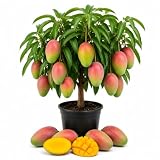
Mango can range from 1.5 m to a towering 40 m depending on cultivar. The grower says it isn’t a houseplant, but dwarf varieties – or even a bonsai – grow and fruit in a large container. He gives a detailed potting method (see the Grower’s Tip).
Quick Details
- Container Size: 50-100 L (10-20 gal) minimum for a dwarf – bigger is better
- Indoor Suitability: Not a houseplant; a dwarf cultivar is a good patio container tree
- Best Spot: Full sun
- Soil & Drainage: Aerated, organic-rich mix that drains freely
- Watering in Pots: Keep the mix consistently moist and water freely in warm weather – pots dry fast; make sure drainage is sharp so roots never sit wet.
Indoors & On the Windowsill
- Houseplant limits: Not a houseplant – mango demands full, strong sun that indoor light can’t provide.
- Windowsill growing: Too large and light-hungry for a sill; grow a dwarf in a big pot outdoors.
- Overwintering: Frost-tender, so in cold areas keep a potted dwarf mobile and move it to a bright, frost-free spot for winter.
On a Balcony or Patio
- Light & heat: Give it the hottest, sunniest spot. A large pot is heavy – make sure the balcony can take the weight – and check moisture often, as reflected heat dries pots fast.
- Choose a dwarf: Only dwarf cultivars (or a bonsai) stay pot-sized; standard mangoes are far too large.
Choosing the Pot, Soil & Long-Term Care
- Pot & drainage: Make plenty of drainage holes; use potting mix or peat soil with perlite and organic matter. If you stand it on a saucer, never let water sit more than a day – overwatering ruins the soil and roots.
- Potting mix: Well-aerated, organic-rich mix – peat or coir with perlite and a little organic matter; it must drain freely.
- Feeding: Feed at least once a year and add humus, ideally twice a year, as the grower advises – potted mangoes are hungry.
- Repotting: Every few years swap part of the soil (from the side and top) and trim some of the root ball rather than replacing everything.
Grower’s Container Tip
- Dwarf or bonsai, potted up in stages: Grow only dwarf species or a bonsai, and limit root growth. Start in a pot about 50% bigger than the root ball and move up a size at a time – don’t start a small tree in a huge pot, as that harms the soil’s vitality. Use at least a 50-100 L (10-20 gal) container, bigger being better. Consider grafting for good-quality fruit, or start from a cutting; such a tree can fruit while only about 1 m (40 in) tall.
Bloom & Flower Guide
Quick Details
- Bloom Season: Late winter to spring, sometimes into summer in cooler areas
- Time to First Bloom: Usually 3-5 years from seed; grafted trees often flower in 2-3 years
- Flower Appearance: Tiny (about 1 mm) white-green flowers carried in large branched clusters (panicles)
- Edibility: The flower is not eaten; the tree is grown for its edible fruit
Detailed Blooming Overview
A mango carries hundreds to thousands of tiny flowers in large terminal panicles. Each panicle holds a mix of male and bisexual flowers, and only a small share ever set fruit – this heavy natural shedding is completely normal.
Flower Characteristics
- Tiny white-green flowers, about 1 mm across.
- Massed in large branched inflorescences (panicles).
- Each panicle carries both male and bisexual flowers.
Bloom Care & Thinning
- Pollination: Bees and other insects (flies visit too).
- Thinning: In the first couple of years many growers remove the blooms so a young tree can build its frame. A mango usually sheds its own excess flowers and fruitlets, but thinning helps if it holds too heavy a set.
Bloom Health & Protection
- Powdery mildew can coat and kill the panicles in cool, humid spring weather – a sulfur-based fungicide is a common preventive.
- Anthracnose blackens flowers and young fruit in wet conditions – a copper-based fungicide and good airflow help keep it in check.
Pruning, Training & Seasonal Maintenance
Mango is a large evergreen tropical tree that needs only light, purposeful pruning — it flowers on terminal panicles produced by mature vegetative flushes, so heavy cutting removes potential bloom sites and delays cropping for a season or more. The main objectives are building a strong low framework while young, keeping the canopy open and low enough to harvest, and thinning congested inner shoots where aphids, sooty mould and anthracnose concentrate. On a bearing tree the safest time to prune is straight after harvest (summer to autumn), before the flushes that will carry next season’s flowers have hardened.
Pruning & the Edible Harvest
The edible crop is the fruit, borne on terminal panicles at the tips of matured flushes. This makes pruning timing decisive for the harvest: cut a shoot tip and you remove its potential panicle, so pruning is kept light and done straight after harvest, leaving a full warm season for new flushes to harden and initiate flowers. Heavy or late cutting pushes leafy growth at the crop’s expense.
Quick Pruning & Maintenance Specs
| Pruning Tolerance |
Low to Moderate (avoid heavy heading on a bearing tree) |
| Primary Pruning Window |
Immediately after harvest (summer–autumn) |
| Secondary Maintenance Window |
Any time for dead, broken or aphid-infested inner shoots |
| Typical Frequency |
Once a year |
| Main Objective |
Low harvestable framework and an open, well-lit canopy |
| Young Plant Priority |
Tip young leaders to force 3–4 scaffold branches low on the trunk |
| Mature Plant Priority |
Height containment and thinning shaded interior wood |
| Best Tool Type |
Bypass secateurs for shoots; loppers and a pruning saw for scaffold limbs |
| Avoid Heavy Pruning During |
Flowering and fruit set; before winter cold in marginal (zone 10a) sites |
Pruning by Plant Age & Size
Newly Established
In the first season remove only broken or crossing shoots. A young grafted tree that is unstable can have its top lightly shortened at planting to balance it against the root ball, but otherwise let it build leaf area.
Young / Formative
Mango responds well to an open-centre or low modified-leader frame. Tip the leader at roughly 0.7–1 m to force a first tier of 3–4 well-spaced scaffolds, then tip those once they harden to build a spreading head. Formative tipping in the first 2–3 years multiplies terminal shoots — and therefore future flowering sites — while keeping the eventual tree low enough to harvest.
Mature / Established
Keep interventions light: shorten the tallest verticals to hold picking height, and thin a portion of the congested inner shoots so light and spray reach the interior. Because each flush must mature before it can flower, remove no more than a modest fraction of the canopy in any one year.
Seasonal Pruning Schedule
Post-Harvest (main structural window)
Objective: reset height and open the canopy while a full warm season remains for regrowth to mature and initiate flowers. Remove over-tall verticals, dead and rubbing wood, and crowded interior shoots. Do NOT remove healthy, well-placed terminal shoots that will carry next season’s panicles. Expected response: fresh vegetative flushes that harden before the next bloom. Fruiting impact: correctly timed, none; late or heavy cutting sacrifices the next crop.
Ongoing Sanitary
Objective: break the aphid, sooty-mould and anthracnose cycle. Remove infested or blackened inner shoots and leaves around developing fruit as they appear. This is done as needed, not on a fixed season.
Flowering & Fruiting Wood
Mango flowers on terminal panicles borne at the tips of vegetative flushes that have matured and rested — typically the previous season’s growth. This is the single most important pruning fact for the species: cut a shoot tip and you remove its potential panicle. Prune early enough after harvest that new flushes can fully harden before the cool, dry period that triggers flowering; heavy or late pruning pushes soft vegetative growth at the expense of bloom and can skip a year of fruit. In the first two years remove or thin flower panicles so the young tree builds structure rather than setting fruit it cannot support.
Structural Pruning & Training
Select 3–4 wide-angled scaffolds and remove narrow, included-bark forks that split under fruit load. Take out crossing and inward shoots to keep an open vase; a modestly open interior improves colour and reduces disease far more than aggressive thinning, which only triggers a flush of upright watersprouts.
Special Growth to Remove
Because quality mango is grafted, remove any suckers arising below the graft union — they carry rootstock genetics, not the named cultivar. Strongly upright interior watersprouts can be thinned, but a few well-placed ones may be retained and tipped to replace old scaffold wood.
Container & Small-Space Pruning
Only dwarf selections or bonsai-trained trees are practical in pots. Here pruning maintains a compact head in balance with a restricted root system: tip new flushes to keep the tree low and branched, and pair canopy trimming with periodic root-ball reduction at repotting rather than one-sided hard topping.
Tools
Use bypass secateurs for shoots up to pencil thickness, loppers for limbs to about 2–3 cm, and a pruning saw for scaffold-sized wood; a pole pruner or pole saw helps with height reduction on a tall specimen. Hedge shears are never appropriate — mango needs selective thinning cuts, not sheared surfaces.
Tool Hygiene & Disease Risk
Risk level: Increased. The routine aphid and sooty-mould problem is not tool-borne, but anthracnose and bacterial black spot can be carried on blades. Keep tools clean and sharp, and disinfect between cuts specifically when removing diseased or cankered wood.
Cut Placement & Technique
Favour thinning cuts (removing a shoot back to its origin) over heading cuts, which provoke dense regrowth. Cut just outside the branch collar, avoid flush cuts and long stubs, and undercut then remove heavy limbs in stages so the bark does not tear.
Heavy Pruning & Rejuvenation
Mango does tolerate hard renewal — an old or over-tall tree can be cut back to main scaffolds and will regenerate vigorously from latent buds — but expect to lose one to two seasons of fruit and to manage the resulting flush of watersprouts. Spread severe height reduction over two or three years rather than dehorning the whole tree at once, and protect newly exposed limbs from sunburn.
Post-Pruning Care
After opening the canopy, whitewash or otherwise shade suddenly exposed bark and scaffold limbs against sunburn in strong tropical sun. Maintain even moisture on the new flush; do not push extra nitrogen after heavy pruning, as the cuts already force vigorous regrowth. Watch the new flush for aphids and clean them off early before colonies establish.
Common Pruning Mistakes
- Shearing or heading shoot tips and then wondering why the tree will not flower — the panicles were on those tips.
- Pruning late (into autumn or winter) in marginal zones, so tender regrowth meets cold.
- Over-thinning the interior, which triggers a thicket of watersprouts instead of fruiting wood.
- Leaving rootstock suckers below the graft to compete with the cultivar.
When NOT to Prune
Do not prune during flowering or fruit set, during drought or heat stress, or in the run-up to cold in zone 10a where soft regrowth is frost-tender. Avoid pruning newly planted trees beyond removing damaged wood until they are established.
Recommended Tools (by task)
- bypass_secateurs — clean thinning cuts on flush-thick shoots and interior sanitary cuts.
- loppers — reach and leverage for 2–3 cm interior and scaffold wood.
- pruning_saw — scaffold-sized limbs during post-harvest height reduction.
Pruning Troubleshooting
| Problem |
Possible Cause |
What to Check |
Corrective Action |
| Vigorous leafy growth but little or no bloom |
Too-heavy or too-late pruning forcing vegetative flushes |
Timing and severity of the last prune; flush maturity going into the cool season |
Prune lightly and early after harvest; let flushes harden before flowering |
| Thicket of upright watersprouts after pruning |
Over-thinned interior or heading cuts |
How much canopy was removed at once |
Thin sprouts selectively; retain and tip a few as replacement wood |
| Blackened, sticky, dieback-prone inner shoots |
Aphid honeydew and sooty mould in a congested canopy |
Interior light and airflow; aphid colonies |
Thin shaded inner wood, remove infested shoots, control aphids early |
| Sunburnt bark on limbs after pruning |
Interior wood suddenly exposed to full sun |
Newly exposed scaffolds |
Whitewash exposed bark; reduce height gradually over seasons |
Pests, Diseases & Troubleshooting
Overview: The mango (Mangifera indica) is a vigorous fruit tree whose crop hinges on managing flowering-time diseases — anthracnose and powdery mildew — together with mango leafhoppers, fruit flies, thrips, mealybugs and scale. The philosophy is preventive: open airy canopies, orchard sanitation, protecting the flush and flowers, and shielding the fruit, with sprays timed to the vulnerable stages rather than applied at random.
Quick Troubleshooting Overview
| Issue / Pest |
Main Symptom |
Primary Solution |
| Mango hoppers |
Buzzing insects on panicles; flower drop, honeydew and sooty mould |
Prune for airflow, sticky monitoring; targeted spray at flowering |
| Fruit flies |
Stung, dropping fruit with maggots inside |
Bag fruit, sanitation, protein-bait/lure traps |
| Anthracnose |
Black spots on leaves, flowers and fruit; rotting fruit |
Airflow, sanitation, protective copper/fungicide at bloom |
| Powdery mildew |
White powder on panicles; flower and young fruit drop |
Sulphur or fungicide at flowering; open canopy |
| Mealybugs & scale |
White fluff or bumps on stems; sooty mould |
Sticky bands on trunk, horticultural oil, ant control |
| Thrips |
Silvery scarring on leaves and fruit skin |
Monitor with traps, spinosad if needed; conserve predators |
Common Pests & Management
- Mango leafhoppers (Idioscopus / Amritodus spp.):
- Symptoms: Wedge-shaped hoppers cluster on flower panicles and new flush, sucking sap so flowers wither and drop, and excreting copious honeydew that fosters sooty mould — a leading cause of crop failure.
- Prevention & Control: Keep the canopy open and airy by pruning, monitor panicles as flowering begins, and apply a targeted, pollinator-safe treatment only at the vulnerable flowering stage; conserve natural predators the rest of the year.
- Fruit flies (Bactrocera dorsalis / Ceratitis capitata):
- Symptoms: Females sting maturing fruit; larvae tunnel the flesh causing premature drop and rot — the key direct threat to harvest.
- Prevention & Control: Bag developing fruit, collect and destroy fallen and stung fruit to break the cycle, and deploy protein-bait sprays and male-lure (methyl eugenol) traps; area-wide sanitation is most effective.
- Mealybugs (Rastrococcus / Drosicha / Planococcus spp.):
- Symptoms: White cottony masses on shoots, panicles and fruit stalks with honeydew and sooty mould; crawlers climb the trunk from the soil.
- Prevention & Control: Fit sticky bands or grease bands around the trunk to stop crawlers climbing, control ants, spray horticultural oil, and encourage predators such as Cryptolaemus.
- Scale insects (Coccidae / Diaspididae):
- Symptoms: Brown, waxy or white bumps on twigs, leaves and fruit; soft scale drip honeydew and blacken foliage with sooty mould.
- Prevention & Control: Prune out heavily encrusted twigs, apply horticultural oil to smother scale, and control ants; spare parasitic wasps and ladybirds.
- Thrips (Scirtothrips / Frankliniella spp.):
- Symptoms: Silvery scarring and bronzing on young leaves, flowers and fruit skin, downgrading fruit appearance and sometimes causing russeting.
- Prevention & Control: Monitor with sticky traps, conserve predatory mites and lacewings, and use a spinosad product if thresholds are exceeded, timed to protect fruit finish.
Diseases & Fungal Issues
- Anthracnose (Colletotrichum gloeosporioides):
- Symptoms: Black spots and blotches on leaves, dark lesions that blast flowers, and sunken black rot on fruit that often appears as the fruit ripens — the single most damaging mango disease in humid climates.
- Treatment & Management: Grow resistant varieties where possible, prune for an open airy canopy, and remove infected debris. Apply protective copper or a labelled fungicide from panicle emergence through fruit set in wet weather, and use hot-water treatment on harvested fruit to curb post-harvest rot.
- Powdery mildew (Oidium mangiferae):
- Symptoms: A white powdery coating on flower panicles, young fruit and new leaves, causing flowers and small fruit to shrivel and drop, worst in dry weather with cool humid nights at flowering.
- Treatment & Management: Keep the canopy open, monitor panicles, and apply sulphur or a labelled fungicide protectively during flowering; time treatments to the bloom period when the disease strikes hardest.
- Bacterial black spot (Xanthomonas campestris pv. mangiferae):
- Symptoms: Angular black, water-soaked, often star-shaped spots on leaves and raised cankers on twigs and fruit, worse in wind-driven rain.
- Treatment & Management: Use clean planting material and resistant varieties, provide windbreaks, prune out cankered wood, and apply copper sprays protectively in wet, windy conditions.
- Sooty mould:
- Symptoms: A black film coating leaves and fruit, growing on the honeydew of hoppers, mealybugs and scale rather than infecting the tree.
- Treatment & Management: Control the sap-sucking insects and the mould flakes away; managing ants and honeydew producers is the real remedy.
Growing Difficulties & Abiotic Problems
- Fruit drop:
- Cause & Symptoms: Heavy shedding of young fruit from irregular water, heat or cold stress, poor pollination, or nutrient imbalance.
- Correction Strategy: Maintain even soil moisture and balanced nutrition through flowering and set, and mulch to buffer the root zone.
- Alternate (biennial) bearing:
- Cause & Symptoms: A heavy crop one year followed by little or none the next, common in many varieties.
- Correction Strategy: Thin excessive fruit in heavy years, feed and water consistently, and choose more regular-bearing cultivars where possible.
- Spongy tissue / internal breakdown:
- Cause & Symptoms: Soft, off-flavoured patches inside otherwise ripe fruit, linked to heat, calcium/boron imbalance and over-maturity.
- Correction Strategy: Maintain balanced calcium and boron nutrition, avoid over-mature harvesting, and manage orchard heat and moisture.
- Sunburn:
- Cause & Symptoms: Bleached, scalded patches on exposed fruit and bark in intense sun, especially after heavy pruning.
- Correction Strategy: Retain enough canopy to shade fruit, and whitewash or shade exposed limbs in fierce sun.
What Helps — Products & Tools
Timing and canopy management matter most — open pruning, sanitation and stage-timed protection. Useful products are copper and labelled anthracnose fungicides plus sulphur for powdery mildew at flowering, fruit-fly protein bait and methyl-eugenol lure traps with fruit bags, horticultural oil and trunk sticky/grease bands for mealybugs and scale, and spinosad for thrips. Time sprays to protect pollinators.
Propagation Guide
The most reliable way to reproduce a named mango is grafting a chosen scion onto a vigorous seedling rootstock — seed alone does not guarantee the parent’s fruit, and grafting also brings a tree into bearing sooner than a seedling. Mango can be raised from seed and, with more effort, from woody cuttings or air layering, but because getting a good fruiting cultivar depends on grafting skill and cultivar compatibility, overall propagation is best rated Difficult.
Quick Propagation Specs
| Best Propagation Method |
Grafting a cultivar scion onto a seedling rootstock |
| Alternative Methods |
Seed (rootstock or polyembryonic types); woody stem cuttings; air layering |
| Propagation Difficulty |
Difficult |
| Seed True-to-Type |
Cultivar-dependent — polyembryonic seed may produce nucellar seedlings true to the mother, while monoembryonic/zygotic seedlings are variable |
| Vegetative True-to-Type |
Yes (grafts, cuttings and layers keep cultivar identity) |
| Best Propagation Season |
Warm season, spring to summer (grafting and sowing) |
| Seed Germination Time |
1–5 weeks, occasionally up to a year depending on conditions |
| Germination Temperature |
21–29°C (70–84°F) |
| Seed Sowing Depth |
4–7 cm measured from the top of the stone |
Growing from Seed
Seed Handling & Viability
Clean all pulp from the stone and dry it on a net. Mango seed is short-lived, so sow it fresh where possible; if it must be held, keep it dry at room temperature and use it as soon as possible. Soaking the cleaned stone in water for about 24 hours before sowing helps; the husk can optionally be eased open a little to speed emergence.
True-to-Type Note
Many mango cultivars are polyembryonic — a single stone yields several nucellar seedlings that are genetically identical to the mother plus one variable zygotic seedling. Monoembryonic cultivars (for example Alphonso) give only variable seedlings. Because you cannot rely on seedlings reproducing the parent’s fruit, seedlings are used mainly as rootstocks or where the cultivar is known to be polyembryonic.
Sowing Season
Sow in spring in hardiness zone 10a, spring to summer in zone 10b, and year-round in zone 11 and warmer.
Sowing Depth & Orientation
Sow shallowly — about 4–7 cm of medium over the top of the stone — in a separate pot per stone. The stone need not be buried deeply.
Germination Conditions
Keep the medium moist and warm at 21–29°C (70–84°F) in full sun with high humidity; water generously and never let the stone dry out, as it will abort if it dries.
Germination Time
Emergence usually takes 1–5 weeks but can occasionally be delayed up to a year depending on temperature and stone freshness.
Seedling Care
Grow seedlings on in full sun with consistently moist soil. Sow several stones and keep the strongest one; graft it before transplanting, because some seedlings reject a graft and grafting first ensures the tree you plant is on its intended cultivar.
Stem Cuttings
Cutting Type
Use fully mature, brown woody wood; mango cuttings are slow and less certain than grafting, so treat this as a secondary method.
Rooting Setup
Keep very high humidity and moist medium inside a closed box or greenhouse that is still well ventilated so air keeps moving; water by misting or fogging and never let the cuttings dry. Hold the rooting environment at about 25–28°C (77–83°F).
Rooting Hormone
A rooting hormone formulated for woody, hardwood cuttings is beneficial here.
Rooting Time
Rooting is slow and erratic; expect several weeks or more under warm, humid conditions.
Grafting & Budding
Why Grafting Is Used
Grafting is the standard way to reproduce a mango cultivar: it preserves the exact fruit — size, season, flavour and other traits — gives better yield and quality than an ungrafted seedling, and brings the tree into production sooner. Several cultivars can be grafted onto one tree.
Rootstock
Use a vigorous, healthy seedling as the rootstock; polyembryonic seedlings are favoured because they give uniform, true-to-type rootstocks.
Scion Selection
Take scion wood from a known, good-fruiting cultivar — decide the fruit size, season, taste and other characteristics before grafting.
Best Grafting Season
Graft in the warm growing season when rootstock seedlings are actively growing.
Graft Aftercare
Graft young seedlings before they go into the ground; grafting first guards against a seedling later rejecting the union. Keep the grafted plant warm and protected while the union knits.
Air & Ground Layering
Air layering is a workable vegetative option for mango where cuttings are difficult: wound and wrap a section of a healthy branch in a moist medium, keep it continuously moist, and separate it once it has rooted. Like cuttings and grafts, a layer reproduces the parent cultivar exactly.