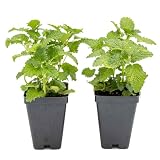
Care Guide: Planting, Soil & Watering
Overview: Lemon balm is a hardy, vigorous perennial herb that grows happily in full sun through to shade in rich, moist soil. It is easy-going and quick-growing, needing only modest but steady moisture and benefiting from a mulch to keep its roots cool.
Quick Care Requirements
| Requirement |
Ideal Condition |
| Planting Season |
In spring through autumn |
| Growth Rate |
Moderate to fast |
| Soil Type |
Rich, moist, well-draining and mulched |
| Water Need |
Low to moderate; keep lightly moist, tolerates short dry spells |
Planting & Establishment
- Best Planting Season: Plant any time from spring through autumn.
- How to Plant:
- Hole Preparation: Loosen a hole a little wider than the root ball in rich soil.
- Soil Amendments: Work in compost or other organic matter and apply a mulch to retain moisture.
- Planting Depth: Set the root ball at the level it grew previously and firm gently.
- Growth Speed & Expectations: Moderate to fast, reaching 20-130 cm; it can spread, so trim it back after flowering.
Soil, Watering & Drainage Care
- Soil Mix & Drainage Needs: Rich, moisture-retentive but well-draining soil; a mulch keeps the roots cool and damp, and in pots a free-draining potting mix works well.
- Watering Schedule & Technique:
- Young / Newly Planted: Keep the soil evenly moist while the plant establishes.
- Established: Water moderately; it tolerates brief dry spells but grows best kept lightly moist.
- Seasonal Adjustments: More in summer heat, less in winter.
Growing in Pots, Balconies & Indoors
Lemon balm is a genuine houseplant – the grower confirms it grows well indoors – and it is forgiving of lower light (it tolerates full sun through to full shade), so it settles happily on most windowsills as well as in patio and balcony pots.
Quick Details
- Container Size: A pot of about 10-15 L (3-4 gal) gives good root room
- Indoor Suitability: A good houseplant; happy on a bright kitchen windowsill for fresh leaves
- Best Spot: Full sun to shade – bright, indirect light indoors is ideal
- Soil & Drainage: Aerated, organic-rich mix that drains freely
- Watering in Pots: Keep lightly moist; it likes modest, steady watering and dislikes drying out fully
Indoors & On the Windowsill
- A true houseplant: Grows well indoors – keep it in bright, indirect light near a window and pinch tips often to keep it bushy and productive.
- Windowsill growing: One of the easiest culinary herbs for a sill; it copes with less light than most, so an east or north window still works.
- Overwintering: A pot brought indoors keeps leaves coming through the cold season when the outdoor plant dies back.
On a Balcony or Patio
- Light & wind: Takes sun or part shade on a balcony; in strong heat some afternoon shade keeps leaves fresh and stops pots drying out.
- Practicalities: Vigorous and spreading – a container neatly keeps its roots in check.
Choosing the Pot, Soil & Long-Term Care
- Pot & drainage: A pot of 10-15 L with strong drainage holes; skip a standing-water saucer to avoid root rot. Terracotta breathes and dries faster; glazed or plastic holds moisture longer.
- Potting mix: A light, aerated, organic-rich mix – potting compost or peat/coir with added perlite or vermiculite for drainage.
- Feeding: Nutrients wash out of pots faster than open ground, so feed potted lemon balm more often – a balanced liquid feed through the active growing season.
- Repotting: Refresh the top layer of mix each year and renew it or pot up every couple of years; lightly trim the roots and top growth when you do.
Bloom & Edible Flower Guide
Quick Details
- Bloom Season: Summer into autumn
- Flower Appearance: Small white flowers in whorls along the upper stems
- Edibility: Edible — the small flowers share the plant’s lemon scent and can be used like the leaves, as a garnish or in tea
Detailed Blooming Overview
Lemon balm (Melissa officinalis) flowers from summer into autumn, carrying small white blooms in whorls up the stems. Its very name comes from the Greek for honeybee, and in bloom the plant lives up to it — the flowers are quietly nectar-rich and a magnet for bees.
Flower Characteristics
- Small white flowers arranged in whorls where the leaves meet the stem.
- Lightly lemon-scented, like the foliage.
Bloom Care & Thinning
- Managing the bloom: If you are growing lemon balm for leaves, it pays to trim off the flowering stems — once the plant blooms and sets seed, the foliage becomes coarser and less fragrant. Leave some flowers if you want them for the bees or the pot.
- Pollination: Worked by bees.
Pruning, Training & Seasonal Maintenance
Lemon balm is a soft, herbaceous perennial with no woody framework, so “pruning” here really means two things: deadheading the flower stalks through summer to keep leaf quality high and stop the plant self-seeding, and one hard cutback to the crown once the top growth dies back with cold. It tolerates heavy cutting extremely well and regrows vigorously from the base, so the safest and most useful time for the big cutback is autumn into winter, after frost has browned the foliage – there is no flowering or fruiting crop being protected, since the plant is grown for its leaves.
Quick Pruning & Maintenance Specs
| Pruning Tolerance |
High |
| Primary Pruning Window |
Autumn / Winter (hard cutback after frost dieback) |
| Secondary Maintenance Window |
Ongoing summer deadheading/pinching of flower stalks |
| Typical Frequency |
Repeated light pinching all season, plus one hard cutback at dormancy |
| Main Objective |
Prolong tender leaf production and prevent unwanted self-seeding |
| Young Plant Priority |
Pinch tips once established to encourage a bushy base |
| Mature Plant Priority |
Deadhead flower stalks through summer; cut the whole plant back near the ground once dormant |
| Best Tool Type |
Precision snips |
| Avoid Heavy Pruning During |
Immediately after transplanting, and during hot, dry stress periods |
Pruning by Plant Age & Size
Newly Established
Leave a newly transplanted or young plant alone except to remove any damaged growth; once it is visibly established, pinch tips to encourage branching.
Young / Formative
No structural training applies to a herbaceous plant like this – formative work is simply repeated tip-pinching to build a fuller, bushier clump.
Mature / Established
Ongoing leaf harvest doubles as pruning: cut stems back near the branch or to a minimum of about 3–5 cm above the ground, which keeps the plant producing fresh tender growth all season.
Seasonal Pruning Schedule
Dormant / Winter
Objective: reset the plant for spring. Once frost has killed the top growth, cut the entire plant back to near ground level, removing all the dead, blackened stems. Expected response: vigorous fresh regrowth from the crown the following spring; there is no flower or fruit crop at stake, so nothing is lost by cutting hard here.
Summer Canopy Management (Deadheading)
Objective: keep leaves tender and prevent excess self-seeding. Pinch or cut out flower stalks as they form through summer, unless the flowers are being left for pollinators. Removing them redirects the plant’s energy back into leaf production and stops it becoming coarse or setting unwanted seed around the garden.
Special Growth to Remove
Flower stalks are the main thing to remove routinely (unless pollinator forage is the goal); old frost-killed stems are removed wholesale at the winter cutback.
Container & Small-Space Pruning
In a container, pinch a little more frequently than an in-ground plant – lemon balm can reach over a metre in the ground, and regular tip removal keeps a potted plant compact and leafy rather than tall and sparse at the base.
Tools
Precision snips are sufficient for every cut this plant needs, from routine pinching to the winter cutback of its soft stems.
Tool Hygiene & Disease Risk
Routine hygiene only – clean, sharp tools. The pest of note (caterpillars/Prodenia) is not spread by pruning tools, so no disinfection routine is required.
Cut Placement & Technique
Cut stems at a leaf node or leave at least 3–5 cm of stem above the ground when harvesting, rather than pulling or cutting into the crown itself, so the base can keep resprouting cleanly.
Heavy Pruning & Rejuvenation
The full winter cutback to near ground level effectively is the rejuvenation for this plant, and it is very well tolerated – expect strong new growth from the crown the following spring with no flowering or fruiting to delay.
Post-Pruning Care
Water in after the winter cutback if the soil is dry; through summer, watch for renewed pest pressure (caterpillars) on the flush of tender regrowth that follows each deadheading round.
Common Pruning Mistakes
Letting flower stalks run to seed unchecked, which coarsens the leaves and lets the plant self-seed aggressively; cutting the plant back hard immediately after transplanting rather than letting it establish first; and leaving the dead winter stems in place, which can shelter pests over the cold season.
When NOT to Prune
Avoid a hard cutback right after transplanting, and avoid heavy cutting during a hot, dry stress period – light harvesting is fine, but wait for cooler, better-watered conditions for a bigger cut.
Recommended Tools (by task)
- precision_snips – the one tool needed for this soft-stemmed herb, from routine deadheading and leaf harvest through to the winter cutback.
Pests, Diseases & Troubleshooting
Overview: Lemon balm is a vigorous, aromatic Lamiaceae herb that is fairly pest-resistant; its foliage oils deter many insects, so its real issues are powdery mildew and rust in crowded humid conditions, aggressive self-seeding, and the usual soft-bodied sap-suckers. As a culinary herb it should be managed with cultural and soft, edible-safe controls first.
Quick Troubleshooting Overview
| Issue / Pest |
Main Symptom |
Primary Solution |
| Powdery mildew |
White coating on crowded leaves |
Airflow, full sun, cut back, bicarb |
| Mint rust |
Orange pustules under leaves |
Remove leaves, airflow, cut back |
| Aphids / whitefly |
Colonies & honeydew on new growth |
Water jet, soap, sticky traps |
| Spider mite / thrips |
Stippling or silvery scarring |
Humidity, predators, soap/spinosad |
| Self-seeding |
Volunteers everywhere |
Shear flowers before seed set |
Common Pests & Management
- Aphids (Myzus persicae / Aphis spp.):
- Symptoms: Clusters of soft green or black insects on new shoots and leaf undersides, curling and puckering the youngest leaves and leaving sticky honeydew.
- Prevention & Control: Blast off with a water jet; pinch out infested tips; encourage lady beetles, lacewings and hoverflies; insecticidal soap on the growing tips if colonies persist — important on a culinary herb, so favour soft controls.
- Two-Spotted Spider Mite (Tetranychus urticae):
- Symptoms: Fine pale stippling, bronzing and delicate webbing on leaf undersides in hot, dry, still conditions.
- Prevention & Control: Raise humidity and hose down foliage; avoid drought stress; encourage predatory mites; a soap or light horticultural oil spray, repeated to catch new hatchlings, in bad cases.
- Thrips (order Thysanoptera):
- Symptoms: Silvery scarring, pale flecking and tiny black frass specks on leaves; distorted new growth.
- Prevention & Control: Remove weeds that harbour them; use blue sticky traps; encourage predatory mites and pirate bugs; insecticidal soap or spinosad only for heavy infestations.
- Whitefly (Trialeurodes vaporariorum):
- Symptoms: Tiny white flies rising from disturbed foliage, yellow stippling and honeydew, mainly under glass or on crowded plants.
- Prevention & Control: Hang yellow sticky traps; improve airflow; release Encarsia parasitic wasps under cover; soap sprays to leaf undersides if needed.
- Caterpillars / Armyworms (Spodoptera spp.):
- Symptoms: Chewed and holed leaves, sometimes with frass, from armyworm and looper caterpillars (the source’s “Prodenia” is an old name for Spodoptera armyworm).
- Prevention & Control: Hand-pick and remove; keep beds weed-free; apply Bacillus thuringiensis (Bt) for serious outbreaks, which is safe on edible herbs.
Diseases & Fungal Issues
- Powdery Mildew (Golovinomyces / Podosphaera spp.):
- Symptoms: White powdery coating on leaves and stems in humid, crowded, shaded conditions — the commonest disease of lemon balm.
- Treatment & Management: Space and thin plants for airflow; cut back congested growth and give full sun; water at the base, not overhead; a potassium-bicarbonate, milk or sulfur spray for stubborn cases.
- Mint Rust (Puccinia menthae):
- Symptoms: Small orange-brown pustules on leaf undersides with pale spotting above; distorted, dropping leaves in damp conditions.
- Treatment & Management: Remove and destroy affected leaves; improve airflow and avoid overhead watering; cut plants back hard and clear debris; severe cases may warrant a sulfur fungicide.
- Septoria Leaf Spot:
- Symptoms: Angular brown spots with pale centres and dark margins on the foliage, worst in wet weather.
- Treatment & Management: Remove spotted leaves and clear fallen debris; improve airflow; avoid wetting the foliage.
- Verticillium Wilt & Root Rot:
- Symptoms: Sudden wilting of shoots, yellowing and collapse from soil-borne fungi, especially in wet, poorly drained ground.
- Treatment & Management: Ensure good drainage and avoid waterlogging; rotate planting sites; remove and destroy badly affected plants, as there is no cure once established.
Growing Difficulties & Abiotic Problems
- Leaf Scorch / Sunburn:
- Cause & Symptoms: Pale, papery or browned leaf edges on plants in fierce sun and dry soil, especially in containers.
- Correction Strategy: Provide a little afternoon shade in hot climates, mulch to conserve moisture, and keep the soil evenly moist.
- Aggressive Self-Seeding:
- Cause & Symptoms: Lemon balm seeds around prolifically and can become weedy.
- Correction Strategy: Shear off flower heads before they set seed to keep it in bounds and encourage fresh leafy growth; remove seedlings while young.
- Root Rot from Overwatering:
- Cause & Symptoms: Yellowing and collapse in soggy soil.
- Correction Strategy: Water when the surface dries; ensure containers drain freely and never sit in water.
- Legginess & Woody Decline:
- Cause & Symptoms: Sparse, leggy, woody growth with fewer fresh leaves in low light or after flowering.
- Correction Strategy: Cut plants back by half after flowering to force tender new foliage; divide and replant every few years to rejuvenate.
What Helps — Products & Tools
Because it is eaten, favour soft and edible-safe options: insecticidal soap for aphids, thrips and whitefly, horticultural oil for spider mite, Bacillus thuringiensis (Bt) for caterpillars, yellow/blue sticky traps, and potassium-bicarbonate, milk or sulfur sprays for powdery mildew and rust — backed by airflow, full sun and hard cut-backs.
Propagation Guide
Lemon balm roots easily from stem cuttings or simple layering, both of which the site confirms take about 2–4 weeks, and established clumps can also be divided. Seed works well for the plain green species, but variegated selections such as ‘Aurea’ must be propagated vegetatively, since their leaf colouring does not come true from seed. Overall this is an easy plant to propagate by almost any method.
Quick Propagation Specs
| Best Propagation Method |
Stem cuttings |
| Alternative Methods |
Ground layering; division of clumps; seed (species only) |
| Propagation Difficulty |
Easy |
| Seed True-to-Type |
Usually true-to-type for the plain species; variegated cultivars do not come true |
| Vegetative True-to-Type |
Yes |
| Best Propagation Season |
Spring / Summer for cuttings and layering |
| Cutting Rooting Time |
2–4 weeks |
| Seed Sowing Depth |
Surface sow or barely cover – fine seed that can benefit from light |
Growing from Seed
Sowing Depth & Orientation
Seed is fine; sow on the surface or just barely cover.
Germination Conditions & Time
Germinates at room temperature in a bright spot, typically within a few weeks, though timing can be somewhat uneven.
Stem Cuttings
Cutting Type
Soft, non-flowering stem tip cuttings.
Best Timing
Spring to summer.
Rooting Setup
Keep cuttings in a shaded spot in moist, well-drained soil, exactly as the site recommends for this method.
Rooting Hormone
Unnecessary – this soft-stemmed mint-family herb roots readily on its own.
Rooting Time
2–4 weeks.
Air & Ground Layering
Bend a low, flexible stem down and cover a section of it with soil while it is still attached to the parent plant; keep conditions the same as for the growing plant, as the site notes. Roots typically form within about 2–4 weeks, after which the rooted section can be severed and potted up or transplanted.
Division, Offsets, Pups & Suckers
Lemon balm forms spreading clumps that can be lifted and split in spring or autumn; make sure each division has both roots and shoots attached. Division is a reliable way to keep a variegated selection true, alongside cuttings.