Care Guide: Planting, Soil & Watering
Overview: Asparagus falcatus (Sicklethorn) is a vigorous, drought-tolerant evergreen (hardiness zone 9–11) for sun or part shade. It prefers moist, well-drained soil but copes with dry conditions once established.
Quick Care Requirements
| Requirement |
Ideal Condition |
| Planting Season |
Spring through autumn, in the warm season |
| Growth Rate |
Moderate to fast |
| Soil Type |
Well-drained; prefers moist soil |
| Water Need |
Low — tolerates dry spells |
Planting & Establishment
- Best Planting Season: Plant from spring through autumn in the warm season.
- How to Plant:
- Hole Preparation: Dig a hole about the width of the root ball, loosening the surrounding soil for the tuberous roots.
- Soil Amendments: Work some organic matter into the backfill; it appreciates a little richness alongside good drainage.
- Planting Depth: Set it at its original depth with the crown at the surface.
- Growth Speed & Expectations: Growth is moderate to fast, reaching about 1–1.6 m.
Soil, Watering & Drainage Care
- Soil Mix & Drainage Needs: Well-drained soil that holds some moisture suits it; its fleshy roots dislike waterlogging. Ordinary potting mix works in containers with good drainage.
- Watering Schedule & Technique:
- Young / Newly Planted: Keep newly planted plants lightly moist while they root in.
- Established: Once established, water sparingly — it needs only a small amount and tolerates short dry spells.
- Seasonal Adjustments: Water a little more in hot weather and cut back in winter.
Growing in Pots, Balconies & Indoors
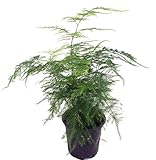
Asparagus falcatus (sicklethorn) is a vigorous, thorny climbing foliage plant reaching 1-1.6 m (40-64 in) or more. The grower does not list it as a houseplant, but like other asparagus ‘ferns’ a young plant can be kept indoors as bright-light foliage; longer term it is really a container plant for a sunny patio or balcony.
Quick Details
- Container Size: A sturdy pot matched to the root ball, with room for its vigorous roots; pot up as it fills out
- Indoor Suitability: Not the grower’s pick as a houseplant, but a young plant grows as bright-light foliage on a sunny sill
- Best Spot: Full sun to half shade – bright light keeps it dense
- Soil & Drainage: Well-drained potting mix – peat/coir with perlite
- Watering in Pots: Small amounts – it is fairly drought-tolerant; let it dry between waterings
Indoors & On the Windowsill
- Indoor reality: The grower marks it as not a houseplant – it is a large, fast, thorny climber. That said, a young plant makes attractive bright-light foliage indoors near a sunny window if you keep it pruned.
- Windowsill growing: Give strong light; in dim rooms it thins and stretches. Mind the sharp thorns when placing it where people brush past.
- Overwintering: Tender to frost – in cold climates bring the pot into a bright, frost-free room for winter.
- Safety: The berries are toxic if eaten and the thorns can scratch – keep away from small children and pets.
On a Balcony or Patio
- Light & support: A sunny to part-shaded balcony or patio suits it; give it something to scramble up or let it cascade, and prune to keep the thorny growth in bounds.
- Practicalities: It is drought-tolerant, so err on the dry side; free drainage matters more than frequent watering.
Choosing the Pot, Soil & Long-Term Care
- Pot & drainage: A strong pot with good drainage holes; its fleshy roots are vigorous, so choose a stable container and skip a standing-water saucer.
- Potting mix: Free-draining – peat/coir with perlite or a good potting mix.
- Feeding: Potted plants exhaust and leach nutrients faster than those in the ground, so feed lightly during active growth – more often than you would in open soil.
- Repotting: Refresh the mix and pot up every couple of years, lightly trimming roots and top growth on perennials to keep them in scale with the pot. Its thick roots can burst thin pots, so pot up before it becomes badly root-bound.
Bloom & Flower Guide
Quick Details
- Bloom Season: Spring
- Flower Appearance: Small, fragrant white flowers with six petals and yellow stamens, borne at the ends of the stems
- Edibility: Ornamental only; this is an ornamental asparagus, not the edible vegetable, and the flowers are not eaten.
Detailed Blooming Overview
Sicklethorn produces sprays of tiny, sweetly scented white flowers at the stem tips in spring. Each little bloom has six petals set off by yellow stamens, and although modest in size the flowers carry a pleasant fragrance across the plant.
Flower Characteristics
- Small white flowers with six petals and yellow stamens.
- Fragrant, clustered at the ends of the stems.
Bloom Care & Thinning
- Encouraging flowers: A bright spot and light, occasional trimming to shape the plant keeps flowering shoots coming.
- A note: This is an ornamental species; do not treat its parts as food.
Pruning, Training & Seasonal Maintenance
Asparagus falcatus is a thorny, scrambling evergreen shrub with wiry, fern-like stems; pruning is informal and mainly for shape, done in autumn or winter. Because the stems carry sharp spines, technique and protective handling matter as much as the cut itself – this is not a plant to shear casually by feel. Used loosely as a hedge or screen, it tolerates a fairly free hand with shaping cuts, but its habit is naturally informal and untidy trimming into a hard geometric hedge line is not typical for the species.
Quick Pruning & Maintenance Specs
| Pruning Tolerance |
Moderate to High – tolerates cutting back for shape |
| Primary Pruning Window |
Autumn to winter |
| Typical Frequency |
As needed for shape/size (informal, not a fixed schedule) |
| Main Objective |
Shape and size control; keep spiny growth away from paths and high-traffic areas |
| Young Plant Priority |
Establish a framework of main canes before shaping |
| Mature Plant Priority |
Remove old or overgrown canes at the base; shape the outline |
| Best Tool Type |
Loppers or a pruning saw for thicker canes, with heavy gloves |
| Avoid Heavy Pruning During |
Spring bloom period, so the fragrant flower display is not cut away |
Pruning by Plant Age & Size
Newly Established
Remove only damaged growth while the plant builds its main canes; avoid heavy cutting until it is established.
Young / Formative
No formal training system is required – the plant naturally scrambles and forms a thicket of wiry canes. If used as a hedge or screen, select and retain a spread of main canes early to set the eventual outline.
Mature / Established
Cut back canes that have outgrown the space, and remove old, woody, or dieback canes at the base to make room for fresher growth.
Structural Pruning & Training
Because it is a scrambling, cane-forming shrub rather than a single-trunk woody plant, renewal by removing the oldest canes at the base is more appropriate than trying to thin a dense canopy of foliage – the fine, needle-like cladophylls do not respond to selective thinning the way a broadleaf shrub’s canopy would.
Special Growth to Remove
- Old, woody, or dieback canes, cut out at the base to make room for newer growth
- Any spiny growth encroaching on paths or areas where people or pets brush past
Tools
- Loppers – for cutting out thicker old canes at the base
- Pruning saw – for any woody canes too thick for loppers
- Bypass secateurs – for lighter shaping cuts on younger growth
Tool Hygiene & Disease Risk
Routine: clean, sharp tools are sufficient; no specific disease-transmission risk is noted for this species. The real hazard when pruning is physical – the spines – so heavy gloves and long sleeves matter more here than blade sterilization.
Cut Placement & Technique
Cut old canes low, at the base, rather than partway up, since new growth will come from the base rather than from a cut mid-cane. Work carefully around the spines and remove cut canes fully rather than leaving thorny stubs in reach.
Heavy Pruning & Rejuvenation
An overgrown thicket can be renewed by cutting a portion of the oldest canes to the base each year rather than removing everything at once, since a wholesale hard cutback removes the current season’s fragrant flowers along with the old growth.
Post-Pruning Care
Water normally after cutting back; watch for regrowth from the base filling in over the following season.
Common Pruning Mistakes
- Shearing the outer surface like a formal hedge, which does not suit this plant’s informal, scrambling habit and leaves cut spiny stem tips at reach height
- Handling cut material without heavy gloves, given the spines
When NOT to Prune
Avoid heavy pruning during the spring bloom period, when the fragrant white flowers are the plant’s main seasonal display.
Recommended Tools (by task)
- Loppers – removing old canes at the base on a mature plant
- Pruning saw – cutting through thicker woody canes
- Bypass secateurs – light shaping cuts on younger growth
Pests, Diseases & Troubleshooting
Overview: Sicklethorn (Asparagus falcatus) is a vigorous, climbing ornamental asparagus with sickle-shaped cladodes and small thorns, sharing the genus’s spider-mite, scale and needle-drop profile. These are ornamental asparagus ‘ferns’ (they are not true ferns, and not the edible vegetable), tough foliage plants whose fine cladodes hide sap-sucking pests and shed ‘needles’ at the first sign of stress. Their most common troubles are spider mites and scale in warm dry indoor air, plus yellowing and leaf drop from watering and light problems; manage them with good humidity, inspection of the fine foliage, and restrained watering into a free-draining mix.
Quick Troubleshooting Overview
| Issue / Pest |
Main Symptom |
Primary Solution |
| Spider mites |
Fine stippling, dull foliage and webbing, heavy needle drop |
Raise humidity, rinse foliage, horticultural oil/miticide |
| Scale & mealybugs |
Waxy bumps or cottony tufts on stems, honeydew, sooty mould |
Wipe/pick off, treat with horticultural oil |
| Aphids |
Sticky, distorted new shoot tips |
Rinse off, insecticidal soap if persistent |
| Yellowing & needle drop |
Foliage yellows and sheds ‘needles’ everywhere |
Fix light/water/humidity; usually a stress signal, not a pest |
| Root rot |
Wilting, mushy tubers/roots in soggy soil |
Reduce watering, improve drainage, repot into open mix |
Common Pests & Management
- Two-spotted spider mite (Tetranychus urticae):
- Symptoms: Fine pale stippling and a dull, greyish cast over the fine foliage, fine webbing between cladodes, and rapid needle drop in hot, dry air — the classic indoor problem for these plants.
- Prevention & Control: Raise humidity and rinse the foliage regularly in the shower; isolate affected plants; apply horticultural oil or insecticidal soap thoroughly (they hide in the fine growth), repeating to catch newly hatched mites.
- Mealybugs (Pseudococcus / Planococcus spp.):
- Symptoms: White cottony tufts tucked into stem junctions and the crown, with sticky honeydew and sooty mould, and slow decline where heavy.
- Prevention & Control: Dab colonies with an alcohol-dipped swab, isolate new plants, control ants, and treat lingering infestations with horticultural or neem oil into all the crevices.
- Scale insects (Pinnaspis aspidistrae (fern scale), soft scale):
- Symptoms: Small brown, tan or white waxy bumps clinging to stems and cladodes; honeydew and sooty mould with soft scale, and yellowing/thinning where numerous.
- Prevention & Control: Wipe or scrape off with a soft cloth or old toothbrush, then smother remaining crawlers with horticultural oil; repeat every couple of weeks until clear.
- Aphids (Aphididae):
- Symptoms: Clusters of soft green or brown insects on tender new shoots, causing sticky, curled, distorted growth.
- Prevention & Control: Rinse off with water, encourage ladybirds and lacewings, and treat persistent groups with insecticidal soap, focusing on the growing tips.
- Thrips (Thysanoptera):
- Symptoms: Silvery streaking and tiny black frass specks on foliage, with fine distortion of new growth in warm dry conditions.
- Prevention & Control: Monitor with blue sticky traps, remove badly affected growth, and treat with insecticidal soap, neem or spinosad, repeating to break the cycle.
Diseases & Fungal Issues
- Root & crown rot (Phytophthora / Pythium / Fusarium spp.):
- Symptoms: Overall wilting and yellowing with soft, dark, decayed roots and tubers, from soggy, poorly drained soil or chronic overwatering.
- Treatment & Management: Water only when the top of the mix begins to dry, use a free-draining medium and pots with drainage, remove rotted material, and repot into fresh open mix if roots are badly affected.
- Fungal leaf spot (various fungi):
- Symptoms: Brown or blackish spots on cladodes and stems, mostly on crowded, chronically wet or poorly ventilated plants.
- Treatment & Management: Improve airflow and spacing, avoid wetting the foliage late in the day, remove affected growth, and keep plants uncrowded; fungicides are rarely needed.
Growing Difficulties & Abiotic Problems
- Yellowing & needle drop:
- Cause & Symptoms: Foliage yellows and sheds its fine ‘needles’ wholesale — the plant’s universal stress response to too little light, drafts, dry air, or erratic (over/under) watering.
- Correction Strategy: Give bright indirect light, keep away from heat vents and cold drafts, maintain humidity, and water consistently so the mix stays lightly moist but never soggy.
- Leaf/tip browning & salt burn:
- Cause & Symptoms: Browning tips and edges from dry air, fluoride/salts in tap water, or fertiliser build-up.
- Correction Strategy: Raise humidity, flush the pot periodically with clean water to leach salts, use low-mineral water where possible, and feed lightly.
- Sunburn:
- Cause & Symptoms: Bleached, scorched foliage when a shade-adapted plant is moved abruptly into strong direct sun.
- Correction Strategy: Keep in bright indirect light, and acclimatise gradually if moving to a brighter spot; avoid harsh midday sun.
- Pot-bound / tuber crowding:
- Cause & Symptoms: Declining vigour, rapid drying and foliage loss as fleshy tubers fill and lift out of the pot.
- Correction Strategy: Repot or divide every year or two into fresh free-draining mix, easing the crowded tuberous roots; note the red berries are toxic if eaten.
What Helps — Products & Tools
These plants respond best to environment control: humidity, bright indirect light, and consistent watering into an open mix. For pests, horticultural/neem oil and insecticidal soap cover spider mites, scale, mealybugs, aphids and thrips (spray thoroughly into the fine foliage); blue sticky traps help monitor thrips. Fungal issues are managed culturally rather than with fungicide. Treat in the cool of the day and rinse foliage as a first line of defence.
Propagation Guide
Asparagus falcatus is easiest to start vegetatively, by dividing an established crown, which the site notes as an easy route even though it isn’t strictly required. Seed is also viable and true-to-type, raised from the small round red berries the plant produces, but it takes longer to reach a usable hedge-size plant. Overall this is an Easy plant to propagate.
Quick Propagation Specs
| Best Propagation Method |
Division of the crown |
| Alternative Methods |
Seed |
| Propagation Difficulty |
Easy |
| Seed True-to-Type |
Yes |
| Vegetative True-to-Type |
Yes |
| Best Propagation Season |
Spring, summer, or autumn |
Growing from Seed
Seed Handling & Viability
Seed is contained in the small round red fruit; clean the pulp away before sowing, since the fleshy fruit coat is not needed and can encourage rot if left on.
Sowing Season
Spring through autumn, matching the plant’s general planting season.
Germination Conditions
Sow in moist, well-drained soil in full sun to half shade.
Division, Offsets, Pups & Suckers
Established plants form a spreading crown that can be lifted and divided into sections, each with roots and some top growth, then replanted directly; this is the easy, quick method the site points to for getting new plants true to the parent.