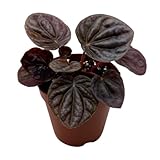
Care Guide: Planting, Soil & Watering
Overview: Peperomia quadrangularis is a compact, semi-succulent evergreen grown mainly for its foliage, suited to warm frost-free gardens (hardiness zone 11b+, or 11a with care) or as a houseplant elsewhere. It likes warmth (above about 16°C), bright indirect light, and a light, rich, well-drained mix kept lightly moist but never soggy.
Quick Care Requirements
| Requirement |
Ideal Condition |
| Planting Season |
Spring in zone 10a; spring–summer in 10b; spring–autumn in 11; year-round in 12+ |
| Growth Rate |
Slow |
| Soil Type |
Light, rich, well-draining and moisture-retentive (peat or potting mix with perlite) |
| Soil pH |
Slightly acidic (around 6.0) |
| Water Need |
Low to Moderate — keep lightly moist, let the surface dry, never soggy |
Planting & Establishment
- Best Planting Season: Plant in spring in zone 10a, spring–summer in 10b, spring–autumn in 11, and year-round in zone 12 and warmer; in cooler areas grow it under cover as a houseplant.
- How to Plant:
- Hole Preparation: Settle the plant into a pot or gap only about 30–50% larger than its root ball; a large volume of wet mix around small roots invites rot.
- Soil Amendments: Blend perlite into a peat- or potting-mix base for aeration, with some humus or organic matter for fertility.
- Planting Depth: Keep the crown at the surface of the mix and do not bury the fleshy stems; firm lightly and water in.
- Growth Speed & Expectations: Expect slow growth even in ideal conditions, so start with a well-grown plant for quicker impact.
Soil, Watering & Drainage Care
- Soil Mix & Drainage Needs: Use a light, airy, well-drained mix — peat or potting mix with perlite and a little organic matter — that holds slight moisture without staying wet. Sharp drainage is essential to prevent root and stem rot; in pots let the base drain fully and never leave the plant standing in water.
- Watering Schedule & Technique:
- Young / Newly Planted: After potting, water lightly and keep the mix just moist while new roots form; rain or clean water is best.
- Established: Water when the top of the mix begins to dry — keep it lightly moist but never soggy, and never leave it in standing water.
- Seasonal Adjustments: Water more often in warm, bright spells and much less in winter when growth slows.
Growing in Pots, Balconies & Indoors
Peperomia is a compact (10-25 cm / 4-10 in) foliage plant that, in the grower’s words, grows well indoors – making it a first-rate, easy houseplant. It thrives in bright shade with no direct sun, so it does not need a sunny sill and is happy on a shelf or table inside a room.
Its small size and modest roots mean a single pot lasts years, and it asks only for steady moisture, humidity and protection from dry drafts.
Quick Details
- Container Size: 10-15 L (2.6-4 gal), at least 30-50% bigger than the plant.
- Indoor Suitability: A very good, easy houseplant.
- Best Spot: Bright shade / plenty of indirect light, no direct sun; away from heating and AC.
- Soil & Drainage: Potting mix or peat soil with perlite plus humus and organic matter; free-draining, kept lightly moist.
- Watering in Pots: Keep the soil moist but never soggy; let the pot base take up water, then drain the same day.
Indoors & On the Windowsill
- Genuine houseplant: Yes, it grows well indoors. Give it good light without direct sun.
- Grower’s indoor care: Protect it from the dry air of heating and cooling machines, keep the soil moist and the air humid, and fertilize at least once a year.
- Windowsill: A bright but not scorching sill is fine; sheer-curtain light suits it best.
On a Balcony or Patio
- Light & shelter: In warm weather it enjoys a shaded, sheltered balcony out of direct sun and wind; bring it in before cold nights.
- Container reality: Small pots dry fast in reflected heat, so check moisture often and mist in dry air.
Choosing the Pot, Soil & Long-Term Care
- Pot & drainage: A 10-15 L pot with strong drainage holes. Give it strong drainage holes and skip a standing-water saucer to avoid root rot; terracotta breathes and dries faster, while glazed or plastic pots hold moisture longer.
- Potting mix: Potting mix or peat soil with perlite, mixed with humus and organic matter; mulch with chopped material to hold moisture.
- Feeding: Potted plants use up their food faster because nutrients wash out with every watering, so feed lightly but more regularly than plants growing in open ground.
- Repotting: Every few years switch to fresh soil – ideally in the cool/dormant season – washing old soil off the roots, trimming roots and pruning the plant.
Grower’s Container Tip
- Soak-and-drain: Let the bottom of the pot fill with water so the soil drinks it up, but make sure it dries out again the same day – never leave it standing wet.
Bloom & Flower Guide
Quick Details
- Bloom Season: Spring into summer
- Flower Appearance: Slim, greenish-white flower spikes shaped like an ice-pop or little boot
- Edibility: Ornamental — grown mainly for its foliage
Detailed Blooming Overview
Peperomia quadrangularis is grown chiefly for its foliage, but it flowers readily, sending up slim, greenish-white spikes shaped like a small ice-pop or boot. Each spike carries many minute, petal-less flowers, so the display is quiet and green rather than showy.
Flower Characteristics
- Slender, greenish-white flower spikes.
- Made up of many tiny, petal-less flowers along the spike.
Bloom Care & Thinning
- Managing the bloom: The spikes are modest; leave them for interest, or snip them off to keep the plant’s energy in its foliage.
Pruning, Training & Seasonal Maintenance
This variegated, striped-leaf Peperomia is grown for its foliage pattern, so pruning has two goals: keeping the trailing succulent growth compact, and removing any shoot that reverts to solid green before it out-competes the variegated growth (variegated tissue photosynthesizes less efficiently, so a reverted all-green shoot tends to grow faster and can take over the plant if left). It tolerates moderate pruning – the source care notes call for roughly once-a-year pruning – and light cutback or pinching is safe at any time of year. Its small white ice-pop-shaped flower spikes are not ornamentally significant, so pruning timing has no real bearing on flowering; it mainly determines fullness and how well the variegation is preserved.
Quick Pruning & Maintenance Specs
| Pruning Tolerance |
Moderate – soft stems respond well to pinching and light cutback |
| Primary Pruning Window |
Ongoing, all year, for tip-pinching, deadheading and reversion checks |
| Secondary Maintenance Window |
Winter, when repotting and refreshing the soil every few years |
| Typical Frequency |
About once a year for a fuller cutback, plus light pinching/reversion checks as needed |
| Main Objective |
Keep growth compact and remove any solid-green (reverted) shoots to preserve the variegated pattern |
| Young Plant Priority |
Pinch growing tips early to encourage branching instead of a single trailing stem |
| Mature Plant Priority |
Annual light cutback; remove spent flower spikes and any reverted all-green growth |
| Best Tool Type |
Precision snips |
| Avoid Heavy Pruning During |
Very low light/winter dormancy periods when regrowth is slow |
Pruning by Plant Age & Size
Newly Established
Leave a newly rooted plant or cutting untouched until it is actively growing; only remove visibly damaged leaves.
Young / Formative
Pinch stem tips once the plant has a few sets of leaves to encourage branching from the base – this is a soft subshrub with no woody framework to train formally.
Mature / Established
Give an annual light-to-moderate cutback to control legginess, and check periodically for any shoot that has reverted to solid green, removing it at its base before it dominates the plant.
Special Growth to Remove
- Dead or yellowing leaves
- Spent flower spikes once the white ice-pop-shaped blooms have finished
- Any stem or shoot that has reverted to plain green leaves, since it will typically grow more vigorously than the variegated growth and crowd it out if not removed
- Overlong, bare-based trailing stems – pinch or cut back to encourage fresh, leafier growth
Container & Small-Space Pruning
Grown almost exclusively in pots as a houseplant. When repotting every few years – best done in winter – wash old soil from the roots, trim back some roots, and prune the top growth at the same time so the canopy stays in balance with the reduced root system.
Tools
Precision snips for pinching soft stem tips, removing dead leaves or spent flower spikes, and cutting out reverted growth – no larger cutting tool is ever needed on this small, soft-stemmed plant.
Tool Hygiene & Disease Risk
Routine – clean tools are sufficient. The species is noted as susceptible to aphids, mealybugs, mites and whiteflies, none of which are spread by pruning cuts, so no special blade disinfection is warranted.
Cut Placement & Technique
Pinch or snip just above a leaf node to encourage a new branch point, cut spent flower spikes back to their base, and cut reverted shoots back to where the variegated pattern is still visible on the stem, or remove them entirely if the whole shoot has gone solid green.
Heavy Pruning & Rejuvenation
Tolerated in moderation – a leggy or overgrown plant can be cut back harder to encourage fresh basal growth. Because propagation from leaf or stem cuttings is easy and reliable for keeping the same cultivar’s coloring, an overly leggy or partly reverted specimen can also be rejuvenated by rooting fresh, well-variegated cuttings rather than hard-pruning the whole plant.
Post-Pruning Care
Keep the soil moist but not waterlogged, and fertilize at least once a year to support regrowth – pair this with the pruning/repotting cycle rather than feeding after every light pinch.
Common Pruning Mistakes
- Ignoring reverted all-green shoots, which gradually outgrow and dominate the variegated growth
- Letting stems trail and go bare-based for too long before pinching, producing a sparse, leggy plant
- Pruning the top growth hard at repotting without also addressing the roots
When NOT to Prune
Avoid heavy cutback during low-light winter periods when growth has slowed and wounds are slow to recover from.
Recommended Tools (by task)
- Any age, pinching/deadheading/reversion removal (precision_snips): all cuts on this soft-stemmed subshrub are small enough for a precision blade – no secateurs, loppers or saw ever apply.
Pests, Diseases & Troubleshooting
Peperomias are compact, generally pest-tolerant houseplants whose real weakness is water management rather than insects. This is a semi-succulent, thick-leaved type, so it is especially prone to rot from overwatering and needs an even grittier, faster-draining mix. The genuine pests are mealybugs, spider mites, fungus gnats, whiteflies and occasional thrips or scale, while the important disorders are overwatering root rot, edema (corky leaf bumps), Cercospora leaf spot and Peperomia ringspot virus. Bright indirect light and a ‘dry-out-then-water’ routine keep them thriving.
Quick Troubleshooting Overview
| Issue / Pest |
Main Symptom |
Primary Solution |
| Mealybugs |
White cottony tufts in leaf axils and on stems |
Alcohol swab, insecticidal soap/oil, isolate plant |
| Spider mites |
Fine stippling, dull leaves, webbing in dry air |
Raise humidity, hose/wipe leaves, insecticidal soap/oil |
| Fungus gnats |
Small black flies around the pot, larvae in wet mix |
Let soil dry, use sticky traps and BTI drench |
| Root rot |
Wilting, mushy stems, blackened roots in wet soil |
Cut back watering, repot into airy mix, remove rot |
| Edema |
Corky raised bumps/scabs on leaf undersides |
Water more evenly, improve light and airflow |
| Leaf spot / ringspot |
Brown ringed spots or ring-shaped distortion |
Remove leaves; discard virus-infected plants |
Common Pests & Management
- Mealybugs (Pseudococcidae):
- Symptoms: White cottony masses tucked into leaf axils, stems and sometimes roots, with honeydew, stunting and leaf yellowing; the commonest peperomia pest.
- Prevention & Control: Isolate the plant, dab visible clusters with a 70% alcohol swab, then treat with insecticidal soap or horticultural oil weekly until clear; drench for root mealybugs and repot if needed.
- Spider mites (Tetranychidae):
- Symptoms: Fine pale stippling, dull or bronzed thick leaves and faint webbing, worst in dry indoor air.
- Prevention & Control: Raise humidity, wipe or hose the foliage, keep the plant from drying out, and treat persistent mites with insecticidal soap or horticultural oil.
- Fungus gnats (Sciaridae (Bradysia spp.)):
- Symptoms: Small dark flies drifting around the pot; their larvae feed in constantly wet mix and can nibble fine roots of seedlings.
- Prevention & Control: Let the top of the mix dry between waterings, use yellow sticky traps for adults, and drench with Bacillus thuringiensis israelensis (BTI) or apply a fine sand top-dressing for larvae.
- Whiteflies (Aleyrodidae):
- Symptoms: Tiny white flies that fly up when disturbed, with honeydew and yellow-flecked leaves; less common but seen in greenhouses.
- Prevention & Control: Monitor with yellow sticky traps, encourage parasitoids in greenhouses, and spray insecticidal soap or horticultural oil on the leaf undersides.
- Thrips and scale (Thysanoptera / Coccidae):
- Symptoms: Thrips cause silvery flecking and distorted new growth; scale appear as brown or waxy bumps on stems with honeydew.
- Prevention & Control: Use blue sticky traps for thrips, scrape off scale, and treat both with insecticidal soap, horticultural oil or spinosad for thrips, repeating to catch new stages.
Diseases & Fungal Issues
- Cercospora leaf spot (Cercospora spp.):
- Symptoms: Raised brown-to-black spots, often on leaf undersides, that enlarge and disfigure the foliage in warm, wet, crowded conditions.
- Treatment & Management: Avoid wetting the leaves, improve airflow and spacing, remove affected leaves, and apply a copper-based fungicide only if it spreads.
- Rhizoctonia / Pythium root and stem rot (Rhizoctonia solani / Pythium spp.):
- Symptoms: Blackened, collapsing stem bases and soft, discoloured roots in soggy mix—the most frequent fatal disease.
- Treatment & Management: Keep the mix airy and let it dry between waterings; remove rotted tissue, take healthy cuttings and repot into fresh, free-draining medium.
- Peperomia ringspot virus (Peperomia ringspot virus (PRSV)):
- Symptoms: Concentric brown rings, ring-shaped chlorotic patterns and distorted, puckered leaves; incurable and spread by handling and propagation.
- Treatment & Management: There is no cure—isolate and discard infected plants, sanitise tools and hands, and propagate only from clean stock.
Growing Difficulties & Abiotic Problems
- Overwatering and root rot:
- Cause & Symptoms: Soggy mix is the number-one cause of peperomia loss: roots suffocate and rot, leaves wilt, yellow and drop, and the base turns mushy.
- Correction Strategy: Use a light, free-draining mix, water only when the top of the soil dries, empty saucers, and repot the moment you see rot, removing affected tissue.
- Edema (oedema):
- Cause & Symptoms: Erratic watering—especially wet, cool, low-light conditions—makes cells burst and form corky raised bumps or scabs, mainly on leaf undersides.
- Correction Strategy: Water more evenly, increase light and airflow, and avoid watering in cool, dim conditions; damaged leaves won’t recover but new growth will be clean.
- Underwatering / low humidity:
- Cause & Symptoms: Very dry mix or air causes limp, curling or crisping leaves and dropped foliage.
- Correction Strategy: Water thoroughly when the surface dries, and provide moderate humidity; most peperomias tolerate average room humidity well.
- Cold and light stress:
- Cause & Symptoms: Cold draughts blacken or drop leaves, while too little light gives leggy, faded growth and too much direct sun scorches leaves.
- Correction Strategy: Keep above about 15°C away from draughts, and grow in bright indirect light, easing into any brighter position gradually.
What Helps — Products & Tools
Care is mostly cultural—light, airy mix and careful watering. Keep 70% rubbing alcohol, insecticidal soap and light horticultural oil for mealybugs, mites, whitefly, thrips and scale; yellow sticky traps and BTI for fungus gnats; and a copper-based fungicide for leaf spot. There is no treatment for ringspot virus—discard infected plants and keep tools clean.
Propagation Guide
Peperomia quadrangularis can be grown from both stem/leaf cuttings and seed, with the site giving detailed sowing figures for this species; cuttings remain the best way to keep this form’s variegated leaf pattern, since the site notes vegetative propagation is needed to reproduce the same cultivar, while seedlings may not match. Propagation is easy by cuttings and moderate by seed given the humidity and warmth required.
Quick Propagation Specs
| Best Propagation Method |
Stem or leaf cuttings |
| Alternative Methods |
Seed |
| Propagation Difficulty |
Easy (cuttings); Moderate (seed) |
| Seed True-to-Type |
Variable – variegation and exact leaf pattern are not guaranteed from seed |
| Vegetative True-to-Type |
Yes – needed to keep the same cultivar |
| Best Propagation Season |
Spring, summer, or autumn for sowing; spring onward for cuttings |
| Seed Germination Time |
4–8 weeks |
| Germination Temperature |
About 25°C (77°F) by day, cooler around 22°C (68°F) at night |
| Seed Sowing Depth |
Surface-sow – press seed onto the soil without covering |
Growing from Seed
Seed Handling & Viability
Store seed in a dry, dark location until sowing.
Sowing Season
Spring, summer, or autumn.
Sowing Depth & Orientation
Surface-sow – press seed onto the soil surface without covering it.
Germination Conditions
A sterile peat-based mix around pH 6, kept moist with high humidity (a covered pot, propagator lid, or plastic bag helps), bright light, and a day/night swing of about 25°C (77°F) by day and 22°C (68°F) at night. Water sparingly and avoid overwatering.
Germination Time
4–8 weeks.
Seedling Care
Keep high humidity and moist soil at around 25°C (77°F); once large enough, separate into individual pots or cells spaced about 2x3cm (1×1.5 inch) apart.
Stem Cuttings
Cutting Type
A stem cutting with at least one node.
Cutting Preparation
Cut the stem carefully, by hand where possible rather than with a blade, taking care not to break or crush the tissue.
Rooting Setup
Let the cut end heal for a few days in the shade until the wound has closed over, then insert it into soil and give it the same conditions as a mature plant.
Rooting Hormone
Not indicated as necessary by the site; can be considered optional.
Rooting Time
Not specified precisely by the site; expect roots and new growth within a few weeks under warm, shaded conditions.
Leaf & Root Cuttings
Leaf cuttings follow the same process as stem cuttings: detach a healthy leaf carefully, preferably by hand rather than cutting, to avoid tearing the tissue, let the wound heal in shade for a few days, then insert it into soil and care for it as a mature plant. Because this form’s leaves are variegated with lighter green stripes, select cutting material from well-variegated stems or leaves – cuttings taken from a shoot that has reverted to solid green will typically grow on as plain green rather than regaining the pattern.