Care Guide: Planting, Soil & Watering
Overview: Pepino is a fast-growing tender perennial that fruits best in full sun in well-draining soil. It needs steady moisture and support, so keep the soil evenly moist and give it something to climb.
Quick Care Requirements
| Requirement |
Ideal Condition |
| Planting Season |
In spring to summer (frost-free, zone 10b+) |
| Growth Rate |
Moderate to fast |
| Soil Type |
Well-draining |
| Water Need |
Moderate to high; keep the soil evenly moist |
Planting & Establishment
- Best Planting Season: Plant in spring to summer in a warm, frost-free spot.
- How to Plant:
- Hole Preparation: Loosen a hole a little wider than the root ball in free-draining soil.
- Soil Amendments: Work in organic matter to enrich and open the soil.
- Planting Depth: Set the root ball level with the surrounding soil and firm gently; add a trellis or support at planting.
- Growth Speed & Expectations: A quick, sprawling grower about 20–60 cm high that needs to spread and fill its space before it fruits; give it a trellis to keep the fruit off the ground.
Soil, Watering & Drainage Care
- Soil Mix & Drainage Needs: Well-drained soil is essential to prevent root rot; it grows well in containers with good drainage.
- Watering Schedule & Technique:
- Young / Newly Planted: Keep the soil evenly moist while establishing.
- Established: Water regularly and deeply to keep the soil moist.
- Seasonal Adjustments: More in summer heat, less in cool weather; protect from frost.
Growing in Pots, Balconies & Indoors
Pepino (pepino dulce) is a warm-season crop, not a houseplant – it needs strong sun to grow and fruit well, so deep indoors it will not thrive. In a large, free-draining container it does well on a sunny patio or balcony, and a compact plant can fruit on a very bright, sunny windowsill. Its sprawling stems appreciate a little support in a pot. Expect roughly 20-60 cm (8-24 in) in good conditions.
Quick Details
- Container Size: About 10-20 L (3-5 gal) with strong drainage holes (general guidance – the grower simply notes containers work well)
- Indoor Suitability: Not a houseplant; only a bright, sunny windowsill will do, and a patio or balcony is better still
- Best Spot: Full sun; it tolerates part shade but bears less fruit
- Soil & Drainage: Well-aerated, organic-rich mix (potting mix, or peat/coir with perlite or vermiculite); must drain freely
- Watering in Pots: Keep evenly moist – pots dry fast, so mulch the surface; never waterlogged
Indoors & On the Windowsill
- Houseplant limits: The grower’s answer is no – it wants full sun that a room’s interior cannot give, so it stays weak and shy to fruit away from a window.
- Windowsill growing: The best indoor option is the brightest, sunniest sill you have; keep the plant compact so it and its fruit get direct light.
- Overwintering: It is a tender perennial and one of the easier nightshades to overwinter indoors in a bright, frost-free spot.
- Safety: Only the ripe fruit is edible – the leaves, stems and unripe green fruit are in the nightshade family and contain solanine, so keep an indoor plant out of reach of children and pets.
On a Balcony or Patio
- Light & wind: Give it the sunniest spot. Walls and paving reflect heat and dry pots fast, so check moisture daily in summer and mulch; shelter a tall plant from wind and stake it if it gets top-heavy.
- Practicalities: A filled large pot is heavy – position it before filling, and keep drainage runoff off the balcony floor.
Choosing the Pot, Soil & Long-Term Care
- Pot & drainage: About 10-20 L (3-5 gal) with strong drainage holes (general guidance – the grower simply notes containers work well) Skip a standing-water saucer, which keeps the roots wet and invites rot. Terracotta breathes and dries faster; glazed or plastic pots hold moisture longer.
- Potting mix: Well-aerated and organic-rich – a quality potting mix, or peat/coir with perlite or vermiculite for drainage.
- Feeding: Potted plants need feeding more often than those in the ground, since frequent watering leaches nutrients away – feed through the growing season with a balanced, organic-rich fertilizer.
- Repotting: Every couple of years refresh the mix and pot on a size; for perennials, lightly prune the root ball and top growth at the same time to keep them vigorous.
Bloom & Flower Guide
Quick Details
- Bloom Season: Spring to summer
- Flower Appearance: Purple flowers edged with a lighter purple
- Edibility: Ornamental only – the flower is not eaten, and the green parts of the plant are toxic
Detailed Blooming Overview
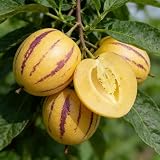
Pepino carries pretty purple flowers, much like a small potato or nightshade bloom, over a long spring-to-summer season. The flowers open in clusters and, once pollinated, give way to the plant’s melon-scented fruit, so keeping the plant flowering steadily is the route to a good crop.
Flower Characteristics
- Star-shaped purple flowers, paler toward the petal edges.
- Borne in clusters with a central cone of stamens.
Bloom Care & Thinning
- Thinning the bloom: Until the plant is well established it helps to thin the flowers so it can build strength before carrying fruit.
- Pollination: Bees and flies visit; the plant is largely self-fertile, and warm, settled weather improves fruit set.
Bloom Health & Protection
- Aphids and thrips can gather on buds and flowers; insecticidal soap or neem oil helps.
Pruning, Training & Seasonal Maintenance
Pepino (Solanum muricatum), the pepino dulce, is a sprawling, brittle, soft-wooded subshrub that behaves more like a scrambling vine than a bush—left alone it flops over a wide area and roots where the stems touch soil. Pruning and training aim to lift and support the plant, thin its tangle so fruit sizes and colours well, and cut away weak and dead growth. It is frost-tender and fruits on new growth, so cutting timing is about vigour, light and manageability rather than protecting stored flower buds.
Quick Pruning & Maintenance Specs
| Pruning Tolerance |
Moderate–High (vigorous, resprouts; stems brittle) |
| Primary Pruning Window |
Winter / dormant lull (frost-free), then light training through the season |
| Typical Frequency |
Occasional through the season as it sprawls |
| Main Objective |
Support and open the plant; thin for fruit size; remove weak/dead wood |
| Young Plant Priority |
Tie to a support early; optional tip-pinch to build a branched frame |
| Mature Plant Priority |
Thin the sprawl, remove weak and spent stems, keep fruit off the soil |
| Best Tool Type |
Precision snips and bypass secateurs |
| Avoid Heavy Pruning During |
Frost, fruit set and fierce heat |
Pruning by Plant Age & Size
Newly Established
Get a stake, cage or trellis in place at planting and start tying the plant up—support is the first priority for this floppy grower. Remove only damaged growth at this stage.
Young / Formative
Rather than a strict system, train a few main stems up a support and pinch the tips to encourage branching and a stronger frame. Removing some of the earliest flowers on a young, not-yet-established plant lets it build size and root before it commits to fruit.
Mature / Established
Thin the tangle of stems so light and air reach the interior, remove weak, spindly and dead growth, and keep fruiting branches tied up and off the soil (ground-lying fruit rots and stems root down where you may not want them). If fruit is small or bland, thinning both stems and fruit concentrates quality.
Seasonal Pruning Schedule
Winter / Dormant Lull
Objective: reset the framework. Remove: weak, dead and over-tangled old stems. Keep: strong young stems for training. Response: tidy vigorous regrowth. Frost note—do this only where the plant is protected from frost.
Summer Canopy Management
Objective: fruit size and light. Remove: crowding weak shoots; tie in and thin. Do NOT strip the outer canopy that shades ripening fruit from scald. Response: better-sized, better-coloured fruit.
Ongoing Sanitary
Objective: limit aphids and ants and keep fruit clean. Remove spoiled fruit and dead growth; lift stems off the soil.
Flowering & Fruiting Wood
Pepino flowers and fruits on current-season growth, so keeping vigorous young stems coming is what sustains the crop; there is no old fruiting wood to preserve. Over-hard cutting simply removes the shoots about to flower and delays fruiting, while gentle thinning that keeps young stems well-lit and supported improves both set and fruit size.
Structural Pruning & Training
Treat it as a plant to be lifted and thinned rather than shaped into a bush: tie a few strong stems to a trellis or cage, thin the rest, and shorten over-long trailing shoots. Because the stems root readily where they touch soil, deciding which stems to keep up and which to let layer is part of the training—layered stems are a free source of new plants.
Special Growth to Remove
Remove weak, spindly and dead stems and any trailing shoots rooting where you do not want new plants; retain the vigorous young stems that carry fruit. Deliberate ground-layering of a healthy stem is a useful way to propagate, so remove only the layers you do not intend to keep. There is no graft, so no rootstock suckers.
Container & Small-Space Pruning
Pepino suits a large pot or hanging position if kept supported and thinned; more frequent tip-pinching keeps the sprawl in check, and a cage or frame keeps fruit off the rim and soil. Keep it to a size the root ball can feed, and take cuttings or layers of the pieces you remove—they root very easily.
Tools
Soft tips and thin stems: precision snips. Firmer semi-woody stems at the base: bypass secateurs. No loppers, saw or pole pruner are needed on this low soft plant, and hedge shears are wrong for its selective, stem-by-stem thinning.
Tool Hygiene & Disease Risk
Classification: Increased. As a nightshade it carries the family’s mechanically spread viruses, and because it is propagated so freely by cuttings and layers, virus can travel on tools and in stock. Use clean tools and wash hands before moving from any mottled or distorted plant; take cuttings only from healthy stock.
Cut Placement & Technique
Cut cleanly just above a node on retained stems, angled to shed water; remove weak whole stems at the base rather than leaving stubs. The stems are brittle and bruise, so use sharp blades and avoid tearing. When layering, nick the underside of a stem at a node and pin it to soil.
Heavy Pruning & Rejuvenation
The plant is soft and vigorous and resprouts readily from a hard cut, so an old tangled specimen can be cut back and retrained—but since cuttings and layers root so easily, replacing a tired plant with a fresh-rooted piece is usually quicker and gives a cleaner framework.
Post-Pruning Care
After thinning, shade newly exposed fruit from scald, keep the soil evenly moist, and re-tie stems so the brittle regrowth is supported. Watch fresh growth for aphids; avoid a heavy nitrogen push that would drive soft leafy growth at the expense of fruit.
Common Pruning Mistakes
- Growing it unsupported, so it sprawls, roots down and rots its fruit on the soil.
- Leaving the tangle unthinned, giving small, poorly coloured, bland fruit.
- Cutting hard just as flowering starts and delaying the crop.
- Feeding heavily and pruning lightly, so leafy growth swamps the fruit.
When NOT to Prune
Avoid pruning in frost or an imminent cold spell, during fruit set, and in fierce heat that would scald newly exposed fruit. Do not hard-prune a plant that is drought-stressed or only just establishing.
Recommended Tools (by task)
- precision_snips — soft tips, tip-pinching and thin stem removal.
- bypass_secateurs — firmer semi-woody stems and whole-stem thinning at the base.
- soft_ties_stakes — tie stems to a trellis or cage and keep fruit off the soil.
Pruning Troubleshooting
| Problem |
Possible Cause |
What to Check |
Corrective Action |
| Sprawling plant, fruit rotting on soil |
No support; stems layering down |
Trellis/cage; where stems touch soil |
Tie stems up; thin the sprawl; lift fruit off the ground |
| Small, bland, poorly coloured fruit |
Over-dense tangle, too much leaf |
Canopy density; feeding |
Thin stems and fruit; ease off nitrogen; improve light |
| Lots of leaf, few flowers |
Heavy feeding, little thinning |
Nitrogen; shoot vigour |
Reduce nitrogen; thin to expose growth to light |
Pests, Diseases & Troubleshooting
Overview: The pepino (Solanum muricatum) is a soft, sprawling nightshade grown for its melon-like fruit; it is easy but shares the tomato/eggplant pest set — aphids, whiteflies, mites and fruit-boring caterpillars — and is prone to sunburnt fruit and root rot. Manage it with rotation, even moisture, light shade over ripening fruit and organic sprays only as needed.
Quick Troubleshooting Overview
| Issue / Pest |
Main Symptom |
Primary Solution |
| Aphids & ants |
Curled tips, honeydew; ants farming aphids |
Rinse, soap/neem, deter ants |
| Whiteflies |
White clouds; honeydew, sooty mould, virus |
Yellow traps, soap/neem, beneficials |
| Spider mites |
Stippling and webbing in dry heat |
Rinse, oil/soap, predatory mites |
| Colorado potato / flea beetles |
Leaf chewing and shot-holes |
Row cover, hand-pick, spinosad if severe |
| Fruit fly & fruitworm |
Boreholes and rot in ripening fruit |
Bag/trap fruit, Bt, hygiene |
| Sunscald |
Pale scorched patches on exposed fruit |
Maintain leaf cover, light shade |
Common Pests & Management
- Aphids (Myzus persicae, Aphis spp.):
- Symptoms: Soft green/black clusters on shoot tips with honeydew and curling; virus vectors, and often tended by ants.
- Prevention & Control: Rinse off, use reflective mulch, encourage predators, deter ants, and spot-treat with soap or neem.
- Whiteflies (Trialeurodes vaporariorum, Bemisia tabaci):
- Symptoms: White insects rising in clouds; honeydew, sooty mould, yellowing and virus spread.
- Prevention & Control: Yellow sticky traps, parasitoids, and insecticidal soap or neem on undersides.
- Spider mites (Tetranychus urticae):
- Symptoms: Stippling, bronzing and fine webbing under leaves in hot, dry conditions.
- Prevention & Control: Keep watered, rinse foliage, release predatory mites, and use soap or horticultural oil.
- Colorado potato & flea beetles (Leptinotarsa decemlineata, Epitrix spp.):
- Symptoms: Striped beetles and grubs stripping leaves; flea beetles riddle foliage with shot-holes, worst on young plants.
- Prevention & Control: Row cover on young plants, hand-pick beetles and eggs, rotate crops, and use Bt or spinosad if pressure is high.
- Fruit fly & fruitworm (Bactrocera / Ceratitis spp., Helicoverpa):
- Symptoms: Sting marks, boreholes and internal rot or maggots in ripening fruit.
- Prevention & Control: Bag or trap fruit, harvest promptly, remove infested fruit, and apply Bt to young caterpillars.
Diseases & Fungal Issues
- Mosaic & other viruses (CMV, PVY, TMV):
- Symptoms: Mottled, distorted, mosaic-patterned leaves and reduced cropping; no cure.
- Treatment & Management: Control aphids and whiteflies, remove infected plants, use clean cuttings, and disinfect tools and hands.
- Powdery mildew (Erysiphales):
- Symptoms: White powdery coating on leaves in warm, humid, still air.
- Treatment & Management: Improve airflow and spacing, and spray sulphur, potassium bicarbonate or horticultural oil.
- Root & stem rot (Phytophthora, Pythium, Rhizoctonia):
- Symptoms: Wilting and yellowing with dark mushy roots and stem bases in wet or poorly drained soil.
- Treatment & Management: Provide sharp drainage, avoid overwatering, and remove badly affected plants; take cuttings to renew stock.
- Early blight & leaf spots (Alternaria solani):
- Symptoms: Target-ring or brown spots on lower leaves in humid weather.
- Treatment & Management: Rotate, mulch to stop soil splash, remove affected leaves, and use copper preventively.
Growing Difficulties & Abiotic Problems
- Sunscald on fruit:
- Cause & Symptoms: The soft skin scorches to pale, papery, sunken patches where fruit is over-exposed to strong sun.
- Correction Strategy: Maintain leaf cover, give light afternoon shade in hot climates, and support sprawling stems off hot ground.
- Poor fruit set:
- Cause & Symptoms: Very hot or cold spells and low light cause flowers to drop before setting.
- Correction Strategy: Grow in warm, sunny, sheltered conditions, feed moderately, and avoid excess nitrogen.
- Root rot from overwatering:
- Cause & Symptoms: Waterlogged soil suffocates the shallow roots, causing yellowing and collapse.
- Correction Strategy: Plant in free-draining soil, water evenly but not excessively, and mulch to steady moisture.
What Helps — Products & Tools
For the pepino the useful kit is insecticidal soap and neem/horticultural oil for aphids, whiteflies and mites, Bt for fruit caterpillars, fruit-fly traps and fruit bags, yellow/reflective mulch and sticky traps for flying pests, sulphur or bicarbonate for mildew, and copper for leaf spots. Light shade over fruit, even watering and sharp drainage prevent the main abiotic problems.
Propagation Guide
Pepino is propagated vegetatively rather than from seed – cuttings root very easily and reproduce the fruit type exactly, whereas seedlings are variable and many good selections set little usable seed. Propagation is easy.
Quick Propagation Specs
| Best Propagation Method |
Stem cuttings |
| Alternative Methods |
Ground layering (bend a branch over and cover it) |
| Propagation Difficulty |
Easy |
| Vegetative True-to-Type |
Yes – cuttings and layers keep the selection true; this is why vegetative propagation is preferred |
| Seed True-to-Type |
Variable, and often not worth using; cultivars are kept vegetatively |
| Best Propagation Season |
Spring to summer |
| Cutting Rooting Time |
About 2–3 weeks |
Stem Cuttings
Cutting Type & Timing
Take stem cuttings in spring or summer – the soft, sprawling stems root readily.
Rooting Setup & Hormone
Stand the cutting in a glass of water, or insert it into moist mix, and keep it in a moist, part-shaded spot. Rooting hormone is not needed but does no harm.
Rooting Time
Roots usually form in about 2–3 weeks.
Air & Ground Layering
Because the stems trail and root where they touch damp soil, layering is very simple: peg a stem down, cover it with earth, and separate it once rooted.